Every year, someone publishes a piece titled "C++ is dying." Serious stuff — well-researched, solid arguments. People share it, like it, nod along.

Meanwhile, C++ is quietly running inside your browser, your GPU, your trading terminal, and your favorite game engine. No comment. No press release.
This has been going on for about twenty years now. I think C++ just doesn't read those articles.
What Is C++ and Where Did It Come From
It's 1979, Bell Labs. A young Danish programmer named Bjarne Stroustrup is modeling telephone networks in C. The codebase keeps growing, and managing it is getting painful. He looks over at colleagues working in Simula — it has classes, elegant object structure. And he thinks: "What if I could take C's speed and add some proper code organization on top?"

That's how "C with Classes" was born. Then came templates, exceptions, the standard library — and in 1983, the language was renamed C++.
The "++" is the increment operator — "C incremented by one." There's still a running joke in the community that it should've been called ++C — that way the improvement would be guaranteed before you use it, not after. Stroustrup has heard the joke. He kept the name anyway.
Now, here's why C++ is so fast — and why it's so demanding. Two sides of the same coin.
Most modern languages run on top of a virtual machine or interpreter. Python turns your code into bytecode, then interprets it on the fly. Convenient? Sure. Fast? Not really. C++ compiles directly to machine instructions — the processor gets exactly what you wrote, no intermediaries, no translators. That's where the speed comes from.

On top of that, you manage memory yourself. Want to allocate? You allocate. Want to free it? You free it. Nobody does it for you. This is what "direct memory access" actually means. It's what gives you hardware-level control that Python or Java simply can't match. And it's the source of every C++ horror story you've ever heard: forget to free memory and it leaks; access the wrong address and your program crashes.
According to the TIOBE index for 2025, C++ holds 3rd place among all programming languages worldwide — right behind Python and C, and ahead of Java, JavaScript, and everything else.

The language is actively evolving: C++11, C++14, C++17, C++20, C++23. Modern C++ and the C++ from a 2005 textbook are practically two different languages with similar syntax. Everything that made old C++ painful has gotten significantly better in the newer standards.
Where C++ Is Used — Real Domains
Game Development and Game Engines
Unreal Engine is written in C++. The whole thing. When a building explodes in Fortnite and the physics engine calculates the trajectory of every piece of debris in real time — that's C++ processing thousands of objects in milliseconds.

Red Dead Redemption, Cyberpunk 2077, God of War — all built on C++ or on engines written in C++. A game has to handle rendering, physics, animation, and networking simultaneously, every 16 milliseconds (that's 60 frames per second). Python can't pull that off. C++ can.
Artificial Intelligence and Machine Learning
What you see is Python. Clean, friendly Python with its model.fit() and five lines of code to train a neural network. But underneath — that's C++, actually pushing matrices through the GPU.

PyTorch is written in C++. TensorFlow too. When a neural network trains for weeks across hundreds of GPUs, every percentage point of performance is money. Tensor operations, CUDA kernels, hardware-level optimization — that's C++. Python is just the pretty front end.
Finance and High-Frequency Trading
On stock exchanges, trading systems make decisions in microseconds. One microsecond is one millionth of a second. By the time Python even starts executing a line of code, a C++ system has already bought, resold, and filed a report.
Citadel, Jane Street, Two Sigma — developers at these firms earn more than at almost anywhere else on the planet. Because they write C++ systems where a 10-microsecond delay translates directly into losses.
Systems Programming and Embedded
Got a computer in your car? That's C or C++. Smart fridge, medical equipment, industrial controller, router? Same deal.
In embedded development, there's no such thing as "memory is cheap." You've got 64 kilobytes and the requirement that it runs without a reboot for five years. When there's a bug in a medical device, that's not a "push a hotfix" situation. You start to understand why specialists command serious money.
Chrome is written in C++. Firefox too. Adobe Photoshop — C++. MySQL, PostgreSQL — C++. Meta moved parts of its infrastructure from PHP to C++ just to cut electricity costs. This isn't niche territory; it's the infrastructure holding the internet together.
C++ vs Other Languages: When to Choose What
The question people ask constantly: "Why C++ when there's Python / Java / Rust?"
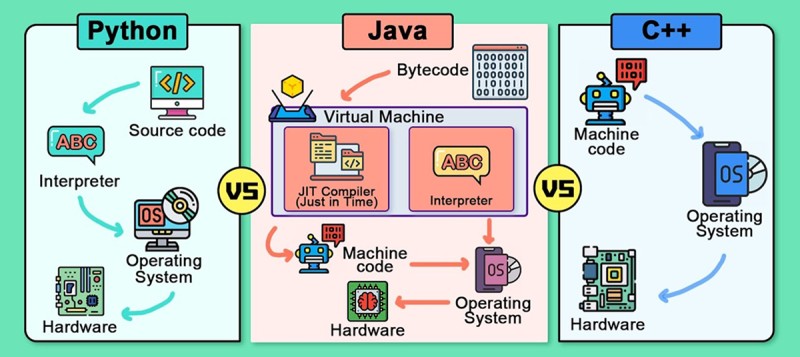
Honest answer: each language has its niche.
C++ vs Python: Python is 10–100x slower on compute-heavy tasks. But Python is simpler and faster to develop with. If execution speed is critical — C++. If development speed matters more — Python. That's exactly why business logic gets written in Python while the libraries Python depends on are written in C++.
C++ vs Java: Java is safer (automatic memory management) but slower and doesn't give you low-level hardware access. C++ is the pick when you need maximum control.
C++ vs Rust: Rust is a newer language solving the same problems as C++, but with stronger memory safety guarantees. Rust is gaining traction, but C++ has forty years of codebase, ecosystem, and tooling behind it. They'll coexist for a long time yet.
Why C++ Developers Earn More
Simple economics. There aren't many people who write C++ well. The problems are complex. The stakes are high.
Based on current market data (Glassdoor, Indeed, Zippia):
- USA: $106,000/year on average. Senior in finance or Big Tech — $150,000–$200,000+
- Western Europe (Germany, UK): €50,000–€90,000
- Eastern Europe: $25,000–$70,000 depending on country and level. Poland, Czech Republic — closer to the upper end ($50,000–$70,000 for senior). Bulgaria, Romania — somewhat lower. Remote work for Western companies regularly pushes these numbers higher
- India: $8,000–$21,000+, noticeably higher at product companies
- China: $37,000–$68,000+, with Beijing and Shanghai at the top end
For comparison: a Python junior and a C++ junior at the same level in the same company don't start at the same salary. C++ wins. Not because the language is "better." Because there are fewer people who know it.
Is C++ Worth Learning in 2026
Honest answer: not for everyone.
If you want to break into tech quickly and build web applications, Python or JavaScript will get you there faster. Genuinely, without irony — that's the right call for most people.
C++ is worth learning if you want to:
- Work in game development — writing engines, not just building games with existing tools
- Get into HFT or finance — where C++ isn't a nice-to-have, it's a requirement
- Work in embedded systems — firmware for smart devices, automotive electronics
- Work on AI infrastructure — optimizing frameworks, building inference engines
There's another argument that rarely gets stated directly. C++ teaches you to think like an engineer. When you manage memory by hand, you see what's actually happening inside the computer. After that, every other language feels different — deeper. People who've been through C++ tend to be strong engineers in any stack.
Not a bad side effect, right?
Here's a story that illustrates the point. Max worked as a sysadmin — managing servers, handling networks, earning decent money. But he could feel the ceiling. He decided to dig into C++ — not for a career pivot, just out of genuine curiosity about how hardware works under the hood. He studied evenings for about a year and a half. Then he stumbled across a job posting at an embedded software company building firmware for industrial controllers. They hired him. Now he works remotely for a German client, and his salary has doubled.
He says the most valuable thing wasn't C++ itself — it was how he started thinking about memory and resources after learning it. That mindset turned out to be just as useful in sysadmin work. He started seeing what was happening under the hood in a completely different way.
Pros and Cons of C++
Pros:
- Maximum performance — only assembly is faster
- Full control over memory and hardware
- Massive ecosystem and 40 years of production codebases
- Cross-platform
- High developer salaries

Cons:
- Steep learning curve — harder than Python or Java
- Manual memory management = you own every leak and crash
- Long compilation times on large projects
- The syntax sometimes looks like it was written by several different people across several different eras — because it was
That last point isn't a dig at the language. It's the reality of forty years of evolution. C++ has accumulated several layers of syntax, and sometimes you can feel it.
Frequently Asked Questions
What is C++ in simple terms?
C++ is a programming language that lets you write very fast programs with direct memory control. It's used wherever performance is critical: games, financial systems, operating systems, AI frameworks.
What is C++ used for?
C++ is used for performance-critical tasks: game engine development, high-frequency trading, embedded systems, systems programming, AI/ML infrastructure.
Is C++ hard to learn?
Harder than Python or JavaScript. Manual memory management, pointers, and templates all take time to get comfortable with. A realistic timeline to your first job is one to two years. But the salaries match.
Is C++ outdated?
No. C++ ranks 3rd in the TIOBE index for 2025. The language is actively evolving — the latest standard, C++23, was released in 2023. In game development, HFT, and embedded systems, it has no real competition.
C++ or Python — which should I learn?
Depends on your goal. Python — for a fast start, ML, web backend, automation. C++ — for game development, systems programming, financial systems, embedded. These are different tools for different jobs.
Try It Right Now
If you want to get hands-on with C++, CodeGym has a course for that. 72 levels, 1,000+ challenges, modern C++23. The explanations are approachable, not textbook-dry. The first level is free — check it out and see if this format clicks for you.
→ Try for free: codegym.cc/courses/cpp
Read Also
- Who Is a C++ Developer — what they do, how much they earn, and how to start your path in the profession
GO TO FULL VERSION