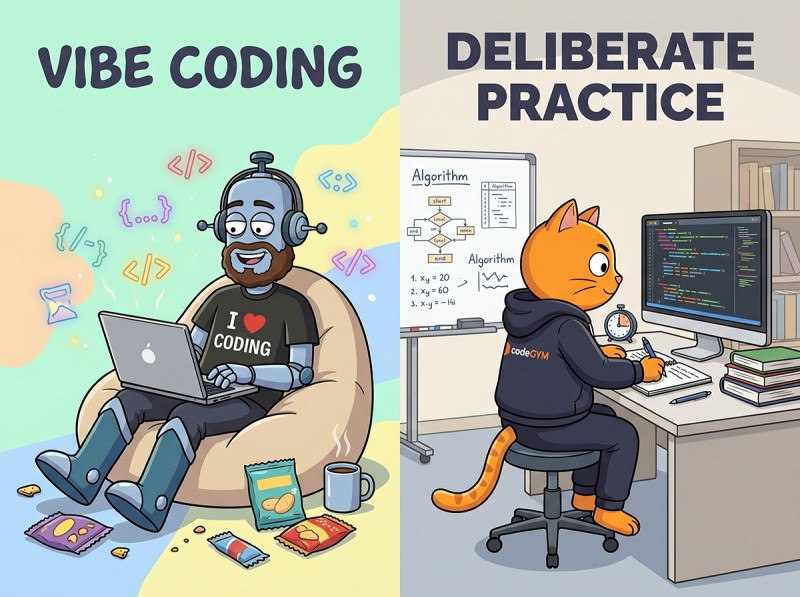
Andrej Karpathy coined "vibe coding" on February 2, 2025 with one tweet: "a new kind of coding where you fully give in to the vibes, embrace exponentials, and forget that the code even exists." Eleven months later, Collins Dictionary named it the Word of the Year 2025, the first peer-reviewed academic paper on the practice appeared (arXiv:2506.23253), and r/learnpython filled up with people doing it. Meanwhile, K. Anders Ericsson's 1993 research on deliberate practice — purposeful, structured skill-building with feedback loops — still describes how humans actually become experts. The two approaches produce dramatically different Python developers. This guide compares them with the underlying research, shows the skill-curve crossover that hits around week 25, and explains why the 2026 hiring market consistently filters for one and not the other. It's supporting article 3 of our Python in the Age of AI pillar page.
Key Takeaways
Vibe coding (Karpathy, Feb 2, 2025; Collins Dictionary Word of the Year) means accepting AI-generated code without reading it. Fast feeling, fast ceiling.
Deliberate practice (Ericsson, 1993 Psychological Review) means structured sub-skill work with feedback loops. Slow feeling, monotonic compound growth.
The skill curves cross around week 25 in focused practice. Before that, vibe coding feels ahead. After, the gap widens permanently.
The 2026 hiring filter is ruthless on this. Vibe coders ship demos and fail technical interviews. Deliberate-practice graduates ship demos AND debug, explain, and architect.
The best 2026 learners use AI WITH deliberate practice. AI compresses the boilerplate phase; verification, reproduction, and explanation remain human.
The structural reason vibe coding plateaus and deliberate practice compounds: feedback signal returns in one loop, doesn't in the other.
Both Terms, Precisely
What "vibe coding" actually means
Karpathy's tweet from February 2, 2025: "There's a new kind of coding I call 'vibe coding', where you fully give in to the vibes, embrace exponentials, and forget that the code even exists. It's possible because the LLMs (e.g. Cursor Composer w/ Sonnet) are getting too good. Also I just talk to Composer with SuperWhisper so I barely even touch the keyboard."
The first academic paper to analyze the practice (arXiv:2506.23253, 2025) frames vibe coding as "programming through conversation with artificial intelligence" with three operational characteristics:
The developer interacts with the codebase through prompts, not through direct text editing.
AI-generated changes are accepted without reviewing the differences ("Accept All").
The developer's role becomes orchestration and selective oversight, not authorship.
Simon Willison's nuanced March 2025 piece draws the key distinction: not all AI-assisted programming is vibe coding. AI-assisted programming WITH careful code review remains traditional software engineering. Vibe coding specifically describes the "accept without reading" mode. The Collins Dictionary entry that crowned the term Word of the Year 2025 codifies that meaning: shipping without auditing.
What "deliberate practice" actually means
K. Anders Ericsson's 1993 paper in Psychological Review with Krampe and Tesch-Römer remains the foundational research. Across studies of expert violinists, chess players, athletes, and surgeons, Ericsson and colleagues found that expertise correlated with one variable above all others: hours of deliberate practice. Not just hours of practice — deliberate practice has specific properties:
Purposeful. Driven by specific sub-skill targets, not "just play around."
Informed. The practitioner understands what's being practiced and why.
Structured. Skills get broken into smaller parts; each part gets repeated.
Focused. Full attention on the gap between current ability and the next target.
Feedback-driven. Each attempt produces evaluable output that guides the next attempt.
For programmers, deliberate practice translates to working on specific weaknesses (debugging without AI, reading unfamiliar codebases, security-audit drills, system-design sketching) with tight feedback loops, not just "ship more features." The arxiv paper "Towards a Theory of Software Development Expertise" (arXiv:1807.06087) extends Ericsson's framework to software specifically, identifying the sub-skills that compound: reading, debugging, naming, decomposition, architectural judgment.
The Crossover Pattern
The loop diagram above shows the structural reason for what plays out in time. Vibe coding ships output without a return path: each iteration starts at the same skill level because nothing was learned from the last one. Deliberate practice closes the loop at IMPROVE: each cycle teaches what to ask better, what to verify carefully, what to reproduce. The temporal pattern that emerges from this structural difference, grounded in Ericsson's 1993 findings on monotonic skill growth plus the emerging AI-assisted learning research:
Weeks 1-12: Vibe Coding Feels Ahead
The vibe coder discovers what AI can do, ships small projects fast, builds a portfolio of demos. The deliberate practitioner spends the first three months on fundamentals: reading existing code, writing functions from scratch, debugging hand-typed errors. Externally the vibe coder looks more productive. Internally, the deliberate practitioner is building reading-and-debugging muscles the vibe coder is skipping.
Weeks 12-24: The Vibe Plateau Approaches
The vibe coder hits a ceiling. The AI can write what the AI can write; the vibe coder's verification skill (the cap on what they can ship safely) didn't grow. Bug reports come in. The vibe coder has to ask AI to fix them, often with several rounds of patches that don't address the underlying issue. The deliberate practitioner, meanwhile, finished foundations and is starting on real projects. Their growth accelerates.
Week 25: The Curves Cross
This is illustrative timing; the exact crossover depends on hours-per-week and quality of practice. The point is structural: at some point the deliberate practitioner's accumulated sub-skills exceed the vibe coder's accepted-AI-output skills.
Weeks 25-50: The Gap Widens
The deliberate practitioner keeps growing. They can now debug efficiently because they spent months debugging hand-typed code, so debugging AI-generated code feels familiar. They can read unfamiliar codebases because they read code as a habit. They can pass technical interviews because they trained for technical interviews. The vibe coder hits the 2026 hiring filter and discovers it.
Why Vibe Coding Plateaus
The structural reason vibe coding hits a ceiling, not a runway:
The AI's ceiling is your ceiling. Whatever the current generation of LLMs can produce reliably is the upper bound of what a vibe coder ships. Improving past that requires verification skill the vibe coder never built.
Feedback loops are broken. The vibe coder doesn't read AI output, so they don't see the patterns in what the AI gets right or wrong. No pattern recognition forms. The skill stays at "I can ask, then accept."
Debugging atrophies. When bugs appear, the vibe coder asks the AI to fix them. If the AI's fix introduces a new bug, the vibe coder asks the AI to fix that. Debugging-by-prompt produces "I made the symptom go away" outcomes, not "I understand the root cause."
False sense of security compounds. The Stanford Perry et al. 2023 study showed AI-assisted developers wrote less secure code AND rated it more secure. Vibe coding maximizes this effect.
For deeper coverage of what AI specifically can't do, see our what AI can't replace supporting article.
Why Deliberate Practice Keeps Growing
The structural reason deliberate practice keeps compounding instead of plateauing:
Sub-skills connect. Debugging becomes faster as reading speed improves. Reading improves as naming sense develops. Naming sense improves as architecture judgment grows. Each sub-skill reinforces the others.
Feedback loops fire correctly. When you read AI-generated code carefully, you build pattern recognition for what AI gets right and wrong. You learn to spot SQL injection, weak crypto, hallucinated packages.
Hard problems become possible. Race conditions, memory leaks, distributed system bugs — the kinds of problems AI assistants can't reliably solve become solvable by the deliberate practitioner.
Transfer happens. Skills built in one Python domain (data engineering, web dev, ML) transfer to others because the underlying patterns are shared. Vibe coding skills don't transfer because they're tied to specific AI workflows.
The 2026 Python Hiring Filter
The signal showing up consistently in 2026 Python interviews:
"Show me a project you built." → Vibe coder shows a polished demo. Deliberate practitioner shows a working project they can explain end-to-end.
"Walk me through this function." → Vibe coder reads it like they're seeing it for the first time (because they are). Deliberate practitioner explains the decisions.
"There's a bug in this code. Find it." → Vibe coder tries to feed it to an AI. Deliberate practitioner reads, hypothesizes, debugs.
"Design a system for X." → Vibe coder produces an architecture diagram the AI drew. Deliberate practitioner explains trade-offs and constraints.
"Why did you pick this library?" → Vibe coder says "the AI suggested it." Deliberate practitioner explains the alternative and why this one fits.
The filter isn't about anti-AI bias. It's about hiring people who can verify, direct, and explain. Vibe coders fail those tests reliably. Deliberate practitioners pass them as a side effect of how they learned. See our is Python still worth learning supporting article for the broader hiring data.
What Deliberate Practice Looks Like for Python Specifically
The six practice patterns that map Ericsson's framework to Python skill-building in the AI era:
Read code as a habit. One hour per week reading an unfamiliar Python codebase (Django, FastAPI, requests source). Name what you don't understand. Look it up. The reading muscle compounds faster than anything else.
Reproduce by hand. When AI writes a working function, close the AI, re-type the function from memory, run it, debug the differences. The next day, re-type it again without looking.
Debug without AI for 15 minutes. When you hit a bug, debug it manually for 15 minutes before asking AI. Form hypotheses. Test them. Read the stack trace methodically. This is the highest-leverage muscle in the 2026 Python job market.
Security drill. When AI writes auth, crypto, file I/O, SQL, or input parsing, ask yourself "what could go wrong" before running anything. Read the OWASP Top 10. Spot the AI's missing checks.
Explain before merging. Talk through what every AI-written line does to a rubber duck (or a teammate, or in your notes). If you can't explain a line, you don't understand it; don't merge it.
Design before coding. Write the architecture down BEFORE asking AI to code it. The writing forces decisions the AI can't make. See the imports and project structure guide for the technical layer.
None of these are dramatic. All of them compound. After 3-6 months of doing them consistently, the crossover happens and the vibe coder's curve flattens beneath you.
The Integration: AI WITH Deliberate Practice
This isn't an anti-AI argument. The best 2026 learners use AI extensively, but they use it WITH the deliberate-practice patterns above active. The integration looks like this:
Step
Vibe coding workflow
AI + deliberate practice workflow
1. Generate
Prompt AI for code
Prompt AI for code
2. Read
Skip
Read every line, predict what it does
3. Verify
Accept diff
Run without AI, confirm prediction
4. Reproduce
Skip
Re-type from memory the next day
5. Explain
Skip
Explain to rubber duck before merging
6. Move on
Move on
Move on
The workflow takes 3-4x longer for any one piece of code. The skill gain ratio is higher than 10x because step 2-5 turn passive AI consumption into active skill building. For the broader AI-assisted learning workflow, see how AI coding assistants change learning Python.
The honest trade-off. AI + deliberate practice is genuinely slower in the first 3-6 months. You'll feel like you're falling behind classmates who vibe-code their portfolios. You're not falling behind; you're building the underwater 90% of the iceberg they're skipping. After the crossover, the gap reverses and keeps growing.
Karpathy's New Term
An interesting footnote: in 2025, Karpathy began using a different term — agentic engineering — for the evolution beyond vibe coding. The new framing is about orchestrating AI agents with explicit verification, evaluation, and feedback loops, which he discussed in his conversation with Stephanie Zhan on the topic. In Ericsson's language, this is the integration version: AI as a tool inside a deliberate-practice workflow, not as a replacement for it. Even the term's originator now signals that pure vibe coding isn't the destination.
Frequently Asked Questions
What is vibe coding and who coined the term?
Vibe coding is a term Andrej Karpathy posted on Twitter/X on February 2, 2025: "a new kind of coding where you fully give in to the vibes, embrace exponentials, and forget that the code even exists." The practice describes interacting with a codebase entirely through AI prompts, accepting AI-generated diffs without reviewing them, and treating coding as conversation rather than text production. Collins Dictionary named "vibe coding" its Word of the Year 2025. The first peer-reviewed academic paper analyzing the practice (arXiv:2506.23253, 2025) defines it as "programming through conversation with artificial intelligence."
What is deliberate practice?
Deliberate practice is the term psychologist K. Anders Ericsson coined in his 1993 Psychological Review paper. It describes a specific kind of practice: purposeful, informed by an understanding of the skill, structured into smaller sub-skills, executed with focus, and tightly coupled to feedback that drives the next iteration. Ericsson's research across multiple expert domains (musicians, athletes, chess players, surgeons) showed that experts didn't have innate talent; they accumulated 10,000+ hours of deliberate practice over a decade. For programmers, deliberate practice means building specific sub-skills (debugging without AI, security review, system design) with feedback, not just shipping code.
Which produces better Python developers in 2026: vibe coding or deliberate practice?
Deliberate practice — but it takes longer to feel like progress. Vibe coding produces shippable code immediately and feels fast, but the skill curve plateaus once the AI's capabilities top out for the human's prompting skill. Deliberate practice starts slow because each sub-skill takes weeks of focused work, but the curve keeps rising because feedback loops compound. The 2026 hiring market consistently filters out vibe-coded portfolios at the technical interview stage: candidates can ship code but cannot debug, reason about architecture, or explain choices. Deliberate-practice graduates pass those filters. The right path uses AI WITH deliberate practice, not as a replacement for it.
How do skill curves between vibe coding and deliberate practice compare?
The illustrative pattern, grounded in Ericsson's research and emerging studies of AI-assisted learning: vibe coding ramps fast (weeks 1-12) as the learner discovers what AI can do for them, then plateaus around weeks 16-20 as the AI's effective ceiling meets the learner's verification ceiling. Deliberate practice ramps slowly (weeks 1-12) as foundations are built, accelerates through weeks 12-30 as sub-skills connect, and continues climbing past the vibe-coding plateau. The two curves typically cross around week 25 of focused practice. After the crossover, the gap widens monotonically because deliberate practice has compounding effects that vibe coding lacks.
Can I use AI assistants while doing deliberate practice?
Yes, and the best 2026 learners do. The pattern: AI generates a candidate solution; you read every line and predict what it does; you run it without the AI and verify your prediction; you reproduce the working result by hand the next day from memory; you explain it to someone (or rubber-duck it) before moving on. This is AI-assisted deliberate practice — the AI compresses the boilerplate phase, but the verification, reading, reproduction, and explanation phases are all you, with structured feedback. Compare to vibe coding: AI generates code, you accept the diff, you move on without verifying or reproducing. Same AI, completely different skill outcomes.
The Bottom Line: Two Curves, One Crossover, Hire-Ready vs Demo-Ready
Karpathy coined vibe coding in February 2025. Ericsson published the foundational deliberate-practice research in 1993. The two approaches produce dramatically different Python developers because they have dramatically different feedback structures. Vibe coding skips reading, verifying, reproducing, and explaining. Deliberate practice puts all four at the center. The skill curves cross around week 25; after that, the gap widens monotonically. The 2026 hiring market filters consistently for what's above the crossover. Use AI extensively — but with deliberate practice patterns active. For more on the workflow side, see how AI coding assistants change learning Python, or browse the full Python in the Age of AI pillar page.
Deliberate Practice, Built Into the Curriculum
CodeGym's Python track is deliberate practice by design: 800+ hands-on tasks across 62 levels, each broken into focused sub-skill targets, each with rapid AI-validator feedback. You build the muscles vibe coding skips: reading, debugging, reproducing, explaining. First level free; full plan on the pricing page.


GO TO FULL VERSION