I checked the stats: over the last 7 years, interest in Python has grown 4x. GitHub, Stack Overflow, Google Trends — explosive growth everywhere. Everyone's rushing to learn Python. The question is: are they all wrong, or am I missing something?
Let's be honest about this. No hype, no "Python is the future" nonsense.
The Numbers Don't Lie (Or Do They?)
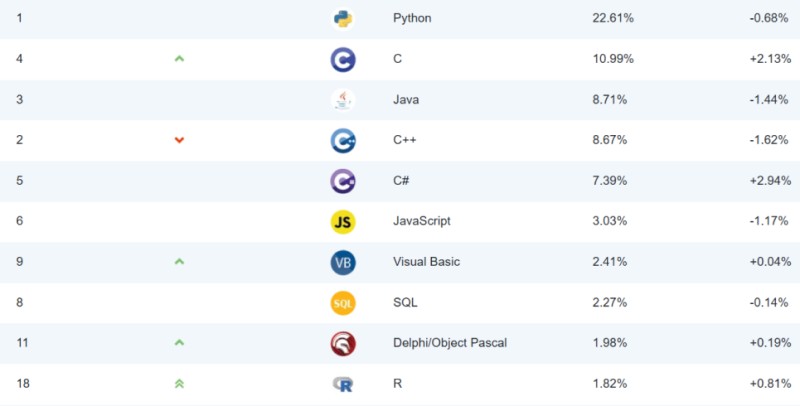
I pulled up the TIOBE Index for January 2026. Python — number one. Third year in a row, by the way. It's overtaken Java, C, C++, and every other dinosaur out there.
Stack Overflow Developer Survey 2025: Python is the third most popular language among professional developers and the number one choice for people just starting to code.
Job listings? LinkedIn currently has over 50,000 open positions mentioning Python in the US and Europe alone. For context: back in 2020, there were around 15,000.
So the numbers say: no, this isn't hype. This is reality.
But why?
Python Has Taken Over the World (Literally)
You know what's most surprising? Python is everywhere now. And I don't mean "everywhere in IT." I mean EVERYWHERE everywhere.

Schools and Universities
Walk into a school — kids are learning Python. Not in some specialized tech program, but in regular classrooms. Where Pascal and Basic used to be taught in CS class, now it's Python.
At universities, it's even bigger: Python has become the standard first programming language. MIT, Stanford, Oxford — they all start with it. Why?
Because students can focus on algorithms and logic instead of figuring out how to declare a variable or where to put a semicolon.
Scientific Research
Physicists, biologists, chemists, mathematicians — they all write Python. Seriously.
A biologist friend of mine processes genomic research data in Python. Not because he's a programmer, but because it's just the standard in his field. Libraries like BioPython make working with biological data as simple as it gets.
Physicists model processes in Python. Mathematicians solve differential equations in Python. Astronomers analyze telescope data in Python.
Non-Technical Professions
And here's where it gets really interesting.
Marketers write scripts to collect competitor data, automate reports, analyze campaign performance. None of them want to become developers. They just need a tool that works.

Financial analysts build forecasting models, automate work with massive Excel spreadsheets, scrape financial data. Again — Python as a tool, not a career.
HR specialists automate resume processing, analyze workforce metrics, build dashboards.
Journalists use Python for data journalism — collecting and analyzing data for investigative pieces.
Designers automate file routines, batch-process images, generate design variations.
See where I'm going with this? Python stopped being "a programmer's language." It's become a language for anyone who wants to automate their work.
QA Engineers
Oh, this one deserves its own section.
Five to seven years ago, a tester could work without writing any code. Now? I look at QA engineer job listings — 80% of them require Python.
Why?
Because pytest and selenium have become industry standards. Test automation in Python is simple, fast, and effective.
A QA friend told me: she used to manually click through interfaces for hours. Now she wrote a Python script that runs the same tests in 10 minutes. And she can run it every hour if she wants.
What Makes It So Special?
Simplicity That Doesn't Annoy You
You know what always used to frustrate me about programming? Writing 50 lines of code just to print "Hello, World" on screen. Or trying to explain data types, pointers, and memory management to a beginner — watching their eyes glaze over.
Python is different.
print("Hello, World")That's it. One line. No public static void main, no semicolons, no mandatory type declarations.
I'm not saying this makes Python a toy. It doesn't. It just doesn't force you to spend months learning syntax before you can write something that actually runs.
A friend of mine with zero programming experience wrote a script in one week that scrapes prices from eBay and sends notifications to a messenger app. One week!
Versatility Without Compromise
Python is used:
- In web development (Django, Flask, FastAPI)
- In data science and machine learning (pandas, NumPy, TensorFlow)
- In automation and scripting
- In testing
- In game development (okay, it's not the top choice here, I'll admit)
- In scientific computing
- In API integration and web scraping
It's like a Swiss Army knife. Not perfect at any one thing, but it handles a ridiculously large number of tasks.
Want to build websites? Python. Want to get into AI and ML? Python. Want to automate the boring stuff at work? Python again.
Libraries for Every Occasion
Python has over 400,000 libraries on PyPI (Python Package Index). Four hundred thousand!
Need to work with Excel? There's openpyxl. With PDFs? PyPDF2. Machine learning? scikit-learn. Data visualization? matplotlib, seaborn, plotly.
Want to build a chatbot? There are libraries for every major messenger. Scraping websites? BeautifulSoup and Scrapy. Working with databases? SQLAlchemy.
Basically, for 90% of tasks there's already a library ready to go. You just need to glue things together.
A Community That Actually Helps
Stuck on a problem? Google it — and you'll find the answer on Stack Overflow. Not just the answer, but an explanation of why it works that way.
Need a tutorial? YouTube has thousands of courses, from beginner to advanced. Documentation? Most libraries have it in great shape.
The Python community is one of the friendliest toward beginners. Seriously. Unlike some other language communities where you might get roasted for asking a "dumb question."
Why Python Became a Language for Everyone

Here's the thing: Python removed the barrier to entry for programming.
In the past, programming was for a select few. You had to think like a computer, understand low-level concepts, master a ton of technical details.
Python turned programming into a tool. Like Excel, only more powerful.
A marketer doesn't want to become a programmer. They want to collect competitor data in 5 minutes instead of 5 hours.
A financial analyst isn't dreaming of a developer career. They need to process a report quickly and go home, not stay late wrestling with Excel.
A researcher isn't planning to move into IT. They just need to analyze experimental data.
Python gave all of them that ability. Without pain. Without kilometers of confusing code. Without "why won't it compile?"
That's why it's taught everywhere. It's no longer "a programming language." It's become basic literacy for the 21st century. Like knowing how to use Word or Excel.
Are There Downsides?
It would be strange if there weren't any.
Execution Speed
Python is slow. That's a fact. Compared to C++ or Java, it loses — sometimes by an order of magnitude.
But you know what? For most tasks, it literally doesn't matter. Your script processed data in 2 seconds instead of 0.2? So what? You'd still spend more time writing the C++ version than you'd ever save on execution.
Speed is critical? Then yeah, Python might not be your best bet. But fewer tasks actually need that than you'd think.
Mobile Development
Want to build mobile apps? Python isn't the go-to. Kivy and BeeWare exist, but they can't compete with native Swift/Kotlin development or even Flutter/React Native.
Multithreading
Because of the GIL (Global Interpreter Lock), Python isn't great at true multithreading. That's its Achilles' heel.
But again: for most tasks, it's not critical. And if you need real parallelism — multiprocessing or async with asyncio have you covered.
Who Should Definitely Learn Python?
Beginners
If you've never programmed before, Python is the perfect starting point. It doesn't overwhelm you with syntax, lets you see results quickly, and won't kill your motivation to keep going.
People Who Don't Want to Become Programmers
Yes, you read that right.
A marketer who knows Python is worth more than one who doesn't. A financial analyst with Python skills isn't just an analyst anymore — they're someone who can automate half the department's work.
You don't need to become a developer. You need a tool that makes your job easier and more efficient.
Data Analysts and Data Scientists
No question here. Python is the industry standard. pandas, NumPy, scikit-learn, TensorFlow — all Python. Want to get into data science? Learn Python.
Automation Enthusiasts
Working with Excel, Word, PDFs, databases? Spending hours on repetitive tasks? Python can automate 90% of that in a couple of hours of your time.
Web Developers
Django and Flask are powerful and widely used. FastAPI is absolutely taking off right now. If you want to do backend work, Python is a great choice.
QA Engineers
pytest, unittest, selenium — test automation in Python has become the industry standard. Without Python knowledge, it's tough to get far in QA today.
Scientists and Researchers
Processing data? Building models? Visualizing results? Python is your best friend.

What Does It Look Like in Practice?
Quick path into the profession
A friend of mine switched from economics to Python development in 4 months. Now he works at a startup doing data analytics. His salary is 2.5x what it used to be.
Fast? Yes. Real? Absolutely.
Career flexibility
Started with web development on Django, switched to ML after a year. Then did some automation work. Now doing backend on FastAPI.
All in one language. That's genuinely convenient.
High demand
Junior Python developer in Europe — from $30–40K/year. Mid-level — $60–90K. Senior — $100K+.
In the US, the numbers are even higher: Junior from $70K, Mid-level $100–130K, Senior $150K+.
Data scientists earn more. ML engineers? That's another level entirely.
Real value even without switching careers
A marketer who automated data collection saves 10 hours a week. An analyst who wrote a script for report processing works faster and more accurately. An HR specialist who automated resume parsing processes 5x more candidates.
This isn't about becoming a programmer. It's about being more effective at your own job.
So Why Is Everyone Rushing to Learn Python?

Because it's genuinely convenient. Genuinely in demand. And it genuinely lets you start doing something useful fast.
This isn't hype. It's a tool that works.
Yes, it has downsides. Yes, it's not perfect. But for most tasks and most people — it's one of the best options out there.
And most importantly: Python isn't just for programmers. It's for anyone who wants to work smarter, faster, and more efficiently.
Want to Give It a Try?
CodeGym has an interactive Python course with hundreds of hands-on tasks, instant code verification, and practice from the very first minute.
The first programs — and there are hundreds of them — are free to complete. The first lectures are free too. Just enough to get a feel for it and decide whether it's for you.
Hundreds of hours of practice, real projects, automatic task checking. All gamified: solve tasks, earn rewards, unlock new levels.
Want to understand why everyone's obsessed with Python? The best way is to try it yourself.
Let's go! 🚀
GO TO FULL VERSION