Prepping for a Python interview used to be simple: Google "top 50 Python interview questions," memorize the answers, show up, recite them. In 2026, that barely works anymore. Memorized definitions sound smooth right up until the first follow-up question — and that's when it becomes obvious whether there's real understanding behind them. So companies started asking differently.
Let's break down how the Python interview process actually works right now, what gets asked at each level — and what now separates "I memorized it" from "I understand it."
How Python Interviews Actually Work in 2026
It's usually not one conversation — it's a gauntlet of 4 to 6 stages:
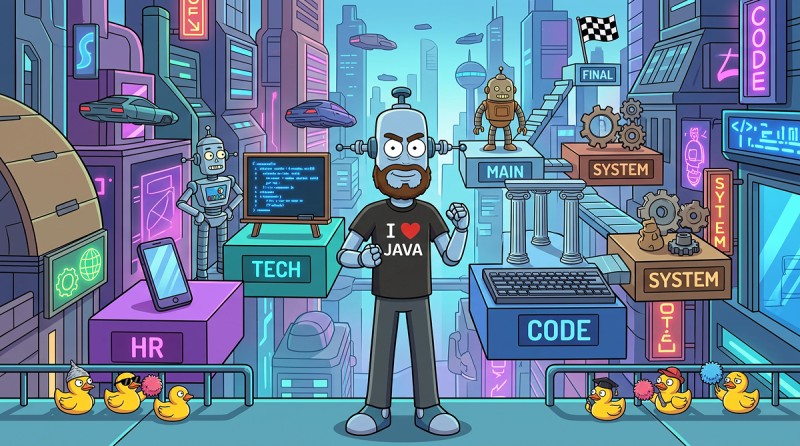
- HR screen (15–30 minutes) — motivation, background, whether you're a sane person to work with. Not about code.
- Technical screen (30–45 minutes) — a quick check of the basics, so engineers don't waste their time later.
- Main technical interview (45–90 minutes) — architecture, databases, testing, and a lot of "why did you do it that way."
- Live coding or a take-home assignment — you write code with them watching, or on your own time. They're not just checking whether it works, but how clean it is.
- Final round — behavioral questions: how you handle a team, a conflict, a deadline.
The higher the level, the less theory and the more conversation about your actual experience. Juniors get grilled on fundamentals. Seniors get grilled on the decisions they made — and the ones that blew up in their face.

The Basics Everyone's Expected to Know
This is the foundation, and it gets asked at every level. Don't know it, and there's not much point moving forward.
- Data types. The classic opener: how's a list different from a tuple. Short version — lists are mutable, tuples aren't, and that's exactly why a tuple can be used as a dictionary key and a list can't.
- Decorators. A decorator is a function that wraps another function and adds behavior to it without touching its code. Logging, caching, permission checks — decorators handle all of it.
- Generators. Lazy evaluation via
yield: values come out one at a time, on demand, instead of loading everything into memory at once. "How's a generator different from a list" is about as close to guaranteed as interview questions get. - Exceptions.
try/except/finally, and knowing what to catch, when, and what you shouldn't silently swallow. - OOP. Encapsulation, inheritance, polymorphism — and being able to explain them with a real example instead of a textbook definition.
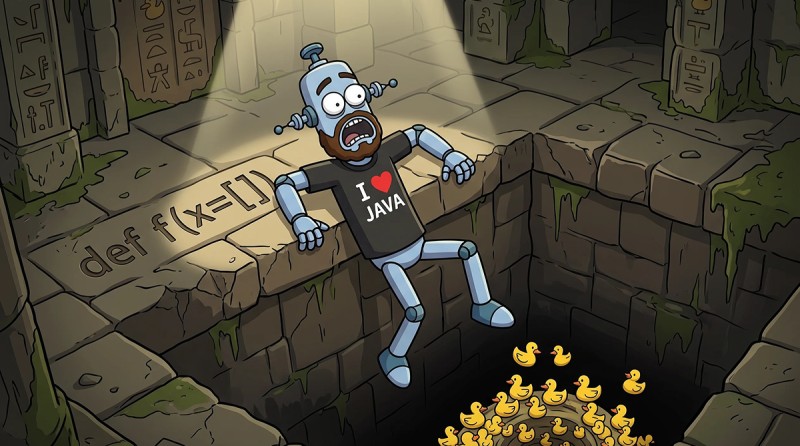
One favorite gotcha deserves its own mention — the mutable default argument (def f(x=[])). If you've never tripped over this bug, you probably haven't written serious Python yet.
Mid-Level: Where Things Get Real
This is where they start separating "I write scripts" from "I run production."
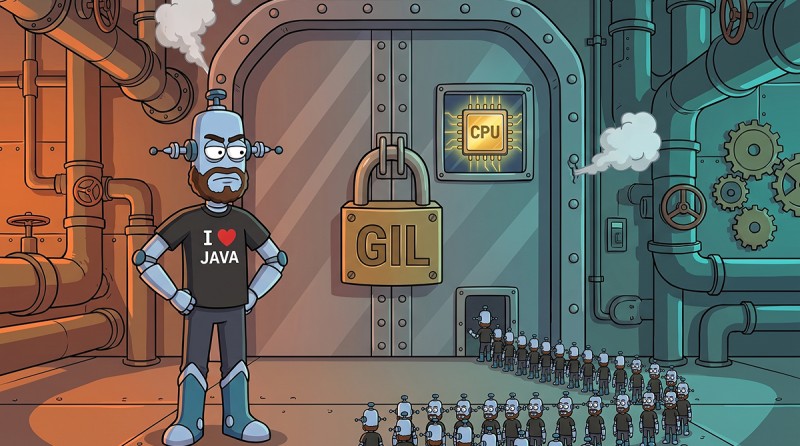
Concurrency. This is where a lot of people fall apart — the GIL (Global Interpreter Lock): the mechanism that lets only one thread execute Python bytecode at a time. The consequences follow from that, and you need to understand them, not memorize them:
- threads (via
threading) are great for I/O — network, disk, waiting around; - processes (via
multiprocessing) get around the GIL and handle heavy CPU work; asyncio— when you need to hold thousands of connections at once without spawning a thread for each.
Databases. This is where they love to poke at real-world pain points:
- the N+1 queries problem — when your code fires off a hundred queries instead of one, and everything crawls;
- indexes and
EXPLAIN— can you actually read how the database executes a query; - ACID and transaction isolation levels;
- connection pooling.
System design. Mandatory for mid-level and up. And here, the "right answer" matters less than how you think out loud: do you clarify requirements, talk through trade-offs, think about scale.
What's Actually Being Tested Now
Here's the real shift. Memorizing a definition — "a decorator is a function that…" — isn't enough anymore. Right behind it comes "why would you use one," "where have you used one," "what breaks if…" They're not testing your memory. They're testing whether you understand what's happening under the hood.
You won't get a question off a list — you'll get broken code and get asked why it's slow. Or be asked to explain why your threading didn't speed up a CPU-bound task (hi, GIL). A memorized answer won't save you here. Understanding the mechanics will.
Which gets us to the main piece of advice for 2026: think out loud. The interviewer cares more about seeing how you think than hearing a rehearsed answer. Clarify the requirements before you write any code. Start with a simple solution that works, then improve it. And be upfront about what you don't know — trying to bluff your way through is obvious from a mile away, and it sinks you faster than a knowledge gap ever would.
AI raised the bar here too: since any chatbot can spit out a textbook definition in a second, memorizing one is a dead-end strategy. What actually gets valued is exactly what AI can't replace — the understanding that's on you.
What It Pays
So why put yourself through this six-stage gauntlet in the first place? Python is one of the most in-demand languages on the planet — per Stack Overflow's 2025 survey, 57.9% of developers use it, and it's a fixture near the top of the TIOBE index. And it pays well, everywhere.
Here's a rough guide to annual salaries (based on aggregators like Glassdoor, Indeed, Jobicy, and ERI — ranges are approximate and depend on company, city, and stack):
| Region | Junior (USD/year) | Middle (USD/year) |
| US | ~$75,000–95,000 | ~$115,000–130,000 |
| Western Europe | ~$45,000–60,000 | ~$70,000–100,000 |
| Eastern Europe | ~$30,000–40,000 | ~$45,000–65,000 |
| China | ~$40,000–54,000 | ~$55,000–75,000 |
| India | ~$5,000–10,000 | ~$12,000–22,000 |

The range is massive — from an entry-level salary in India to the ceiling in the US. And you move up that range not by memorizing answers, but by the same understanding that unlocks the higher levels.
How to Actually Prepare
Let's pull it all together.
- Prep for your level. Juniors: polish the fundamentals — data types, decorators, generators, OOP. Mid-level: concurrency, databases, system design.
- Practice with your hands, not your eyes. A reasonable target before an interview is 75–100 solved problems. Reading about generators and writing them are two completely different sports.
- Learn to explain, not recite. Talk through your solution out loud, just like you would in a real interview.
- Build a foundation, not a collection of answers. That's what actually decides the outcome now — what you understand deeply, AI can't take from you.
If you don't have that foundation yet, that's where you start. On CodeGym's interactive Python course, you're writing code from day one, racking up exactly those hundreds of problems — not watching someone else code. And once you're ready to go deeper — concurrency, real databases, systems that actually hold up — ALL IN ONE lets you stack Python with SQL and Docker instead of learning each one in isolation.
Because the 2026 interview isn't a memory test anymore. It's a test of how you think. And that's exactly the thing worth training ahead of time.
GO TO FULL VERSION