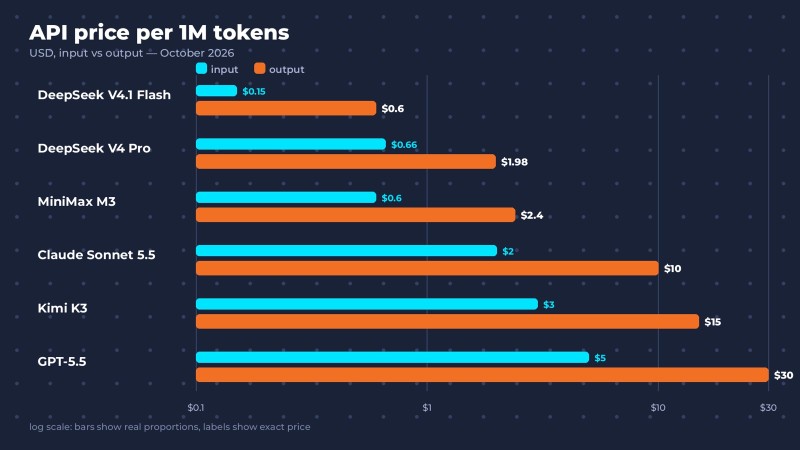
A million output tokens from GPT-5.5 via the API costs $30. Claude Sonnet 5.5 costs $10. DeepSeek V4.1 Flash starts at $0.60.
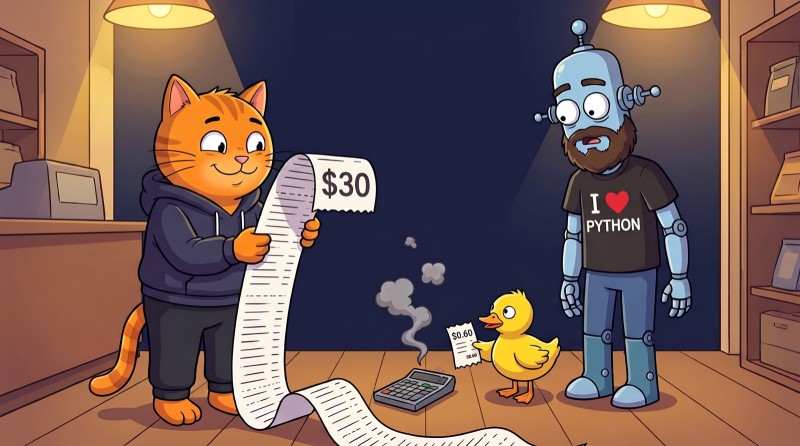
That's not a typo. The gap is tens of times. On top of that, you can download the DeepSeek model in full and run it on your own server, because its weights are published under the MIT license. You could ship it in a product tomorrow.
Sounds like a scam ad from your social feed. But it's the reality of 2026: Chinese labs release models on par with Western flagships almost every month and give them away for free. Developers around the world are already using them.
Let's break down what these models are, what they can actually do, how to connect them to Claude Code — and where the catch is. There is one. More than one, actually.
What open models are and why they matter
The short version: an open-weight model is a neural network whose weights are published for download. You can run it on your own hardware, fine-tune it for your task, and build it into a product with no subscription and without sending data to someone else's cloud.
ChatGPT and Claude are closed models. You can only use them through a website, an app, or an API, while the model itself lives on OpenAI's and Anthropic's servers. An open model you can actually own: download it, and it's yours, on your terms. Exactly how much it's yours depends on the license — more on that below.
Why Chinese labs give their models away
A couple of years ago, open models meant Meta's Llama first and foremost. In 2026 the picture is different. According to Hugging Face's spring report, Chinese open models accounted for 41% of all downloads on the platform between February 2025 and February 2026. American ones accounted for 36.5%.
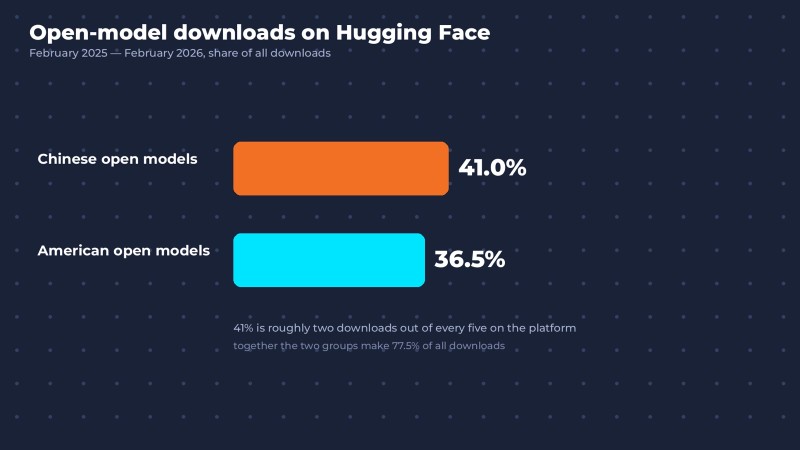
Alibaba's Qwen family has, by various estimates, passed a billion downloads and overtaken Llama. People have fine-tuned more derivative models on top of it than on any other family.
Why would Chinese companies give away what OpenAI and Anthropic charge for? A few reasons:
- It's a market-capture strategy. When developers around the world build products on your model, you become the standard. The money comes later — from cloud, enterprise clients, and the next models.
- Competition inside China. DeepSeek, Alibaba, Moonshot, Zhipu, MiniMax, and ByteDance compete so fiercely that someone ships a new version almost every week.
- Training got cheaper. Chinese labs have learned to train strong models for less, including under restrictions on American chip supplies.
For developers, the takeaway is simple: there's more choice of models in 2026 than ever, and part of that choice is free.
The top Chinese AI models of 2026
One important caveat up front. Versions change so fast here that any review goes stale within a couple of months. Below is the state of things as of late October 2026.
DeepSeek V4: the cheapest API
The same company that crashed Nvidia's stock in January 2025. DeepSeek now has two main models: V4 Pro and V4.1 Flash. The latest Flash version dropped on October 17, 2026, with weights open under the MIT license and a context window of up to a million tokens.

Strength: price. Flash costs tens of times less than Western flagships, and roughly half as much again during off-peak hours. For background automation, document processing, and bulk jobs, it's practically free.
Weakness: reliability on complex agentic tasks. Tom's Hardware, reviewing the new model, specifically noted that it's frugal with memory but hallucinates more often than proprietary competitors in agentic scenarios.
Qwen 3.8: the most popular open model
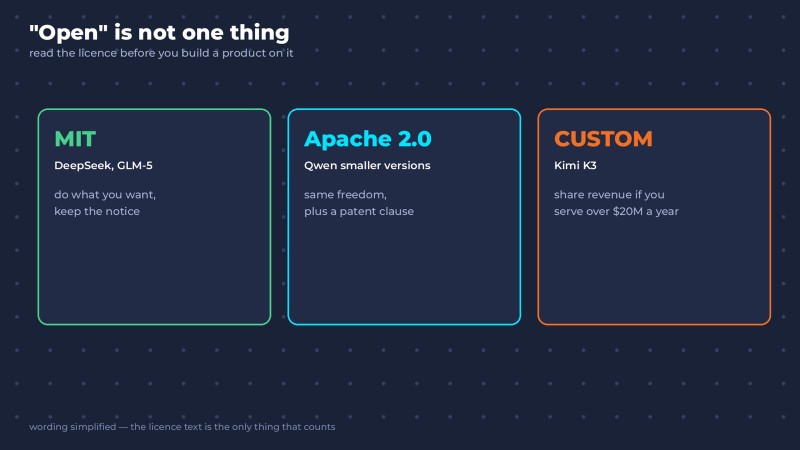
A model family from Alibaba. The current generation is Qwen 3.8, and Qwen 4, according to Alibaba, is in training. Qwen's main strength is the range of sizes: from compact models you can realistically run on your own computer to heavy flagships. Smaller versions ship under Apache 2.0, one of the most permissive licenses.
If you need an open model to fine-tune for your own task, Qwen is the first candidate. That's exactly why more derivative models are built on it than on anything else.
Kimi K3: a flagship for code and agents
A model from Moonshot AI. K3 launched on July 16, 2026, and two weeks later Moonshot published its weights. The size is impressive: 2.8 trillion parameters and a million-token context. The model is built for long agentic tasks: navigating large repositories, debugging, working with tools and logs.
Kimi has made the news before: it recently found a remote code execution vulnerability in Redis in 27 minutes.
The nuance: the license. It's not MIT but a custom one: providers earning more than $20 million a year from K3 inference have to share revenue. As a developer, that's unlikely to affect you, but always read the license before using a model in a product.
GLM-5: an open model for coding
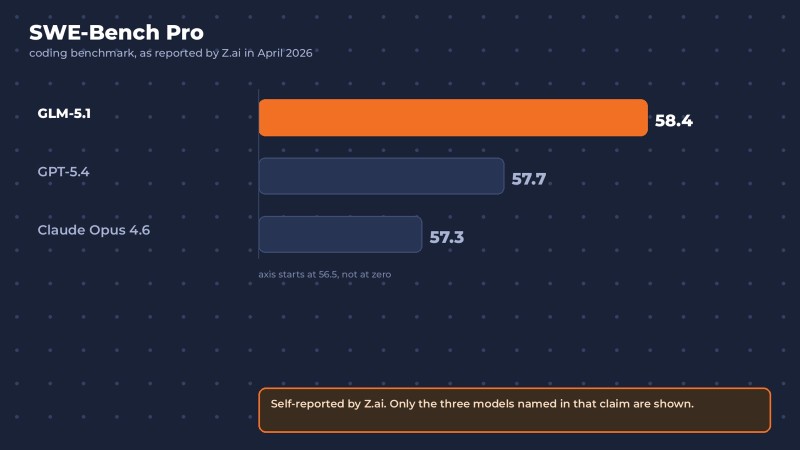
A model line from Z.ai, formerly Zhipu AI. In April 2026 the company released the weights of GLM-5.1 under the MIT license, and by Z.ai's own measurements the model took first place on the SWE-Bench Pro benchmark, ahead of GPT-5.4 and Claude Opus 4.6. Caveat: the result is self-reported, and Z.ai has shipped several more versions since — releases come almost monthly.
For developers, Z.ai offers a separate GLM Coding Plan — a subscription from $18 a month that works right inside Claude Code. More on that below.
MiniMax M3: a million tokens and multimodality
A model from MiniMax, released in summer 2026 with open weights. The company bets on combining three things in one model: strong coding, a million-token context, and native image understanding. A good choice when you need to feed the model a large chunk of documentation or code in one go.
Seedream and Seedance: images and video from ByteDance
Chinese companies aren't just strong at text models. ByteDance — the company behind TikTok — makes image and video generators that compete with the best Western ones.
Seedream 5.0 is an image generator. ByteDance released it in February 2026 as a cheaper alternative to Google's Nano Banana Pro and added a Pro version in the summer. The model outputs 2K and 4K images, edits images from references, and in its Lite version even searches the web before generating. Through OpenRouter, one Seedream 5.0 Pro image costs about $0.045.
Seedance 2.0 is a video generator. Since spring 2026 it's been built right into CapCut and Dreamina, and Dreamina already has version 2.5, which generates clips up to 30 seconds long. For developers, there's an API through BytePlus.
Why should a developer care? Because a product isn't just code. Icons, landing page illustrations, game assets, a launch demo video — all of that used to require a designer, a video editor, and a budget. Now you can build a first version in an evening. One person with code and tools like these ships what used to take a small team.
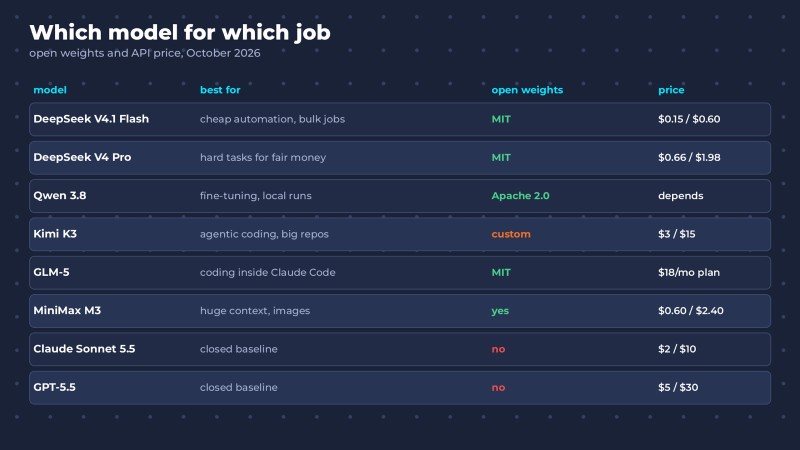
Comparison: which model to choose
| Model | Best for | Open weights | API price (per 1M tokens, input / output) |
| DeepSeek V4.1 Flash | Cheap automation, bulk jobs | Yes, MIT | from $0.15 / $0.60 |
| DeepSeek V4 Pro | Hard tasks for moderate money | Yes, MIT | about $0.66 / $1.98 |
| Qwen 3.8 | Fine-tuning, local runs, choice of sizes | Yes, smaller versions under Apache 2.0 | depends on size and provider |
| Kimi K3 | Agentic coding, large repositories | Yes, custom license | $3 / $15 |
| GLM-5 | Coding, working in Claude Code | Yes, MIT | Coding Plan from $18/month |
| MiniMax M3 | Huge context, images + code | Yes | about $0.60 / $2.40 |
| For comparison: Claude Sonnet 5.5 | — | No | $2 / $10 |
| For comparison: GPT-5.5 | — | No | $5 / $30 |
Chinese providers change prices often, with launch discounts and different rates for peak and off-peak hours. Before you build costs into a product, check the official pricing page.
How to use a Chinese model in Claude Code
Now for the most practical part. Claude Code doesn't only work with Claude models. It sends requests to the address in the ANTHROPIC_BASE_URL environment variable, and DeepSeek, Moonshot, and Z.ai have built APIs compatible with Anthropic's format.
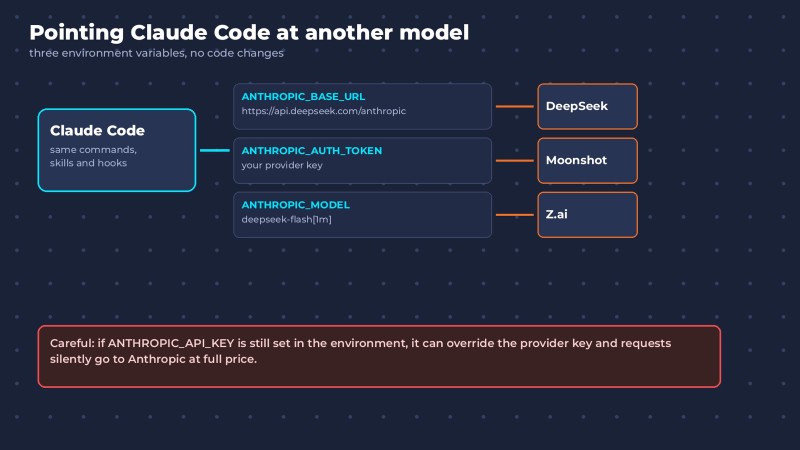
Here's the official setup from DeepSeek's documentation:
export ANTHROPIC_BASE_URL=https://api.deepseek.com/anthropic
export ANTHROPIC_AUTH_TOKEN=<your DeepSeek API key>
export ANTHROPIC_MODEL=deepseek-flash[1m]
export ANTHROPIC_DEFAULT_OPUS_MODEL=deepseek-flash[1m]
export ANTHROPIC_DEFAULT_SONNET_MODEL=deepseek-flash[1m]
export ANTHROPIC_DEFAULT_HAIKU_MODEL=deepseek-flash
export CLAUDE_CODE_SUBAGENT_MODEL=deepseek-flash
claude
The [1m] suffix enables the million-token context. If you leave Claude model names in your settings, DeepSeek routes requests itself: Opus to V4 Pro, Sonnet and Haiku to Flash.
After that, Claude Code works as usual — same commands, same skills, same subagents — but DeepSeek does the thinking. Moonshot for Kimi K3 and Z.ai for GLM follow the same pattern: their own API address and their own key.
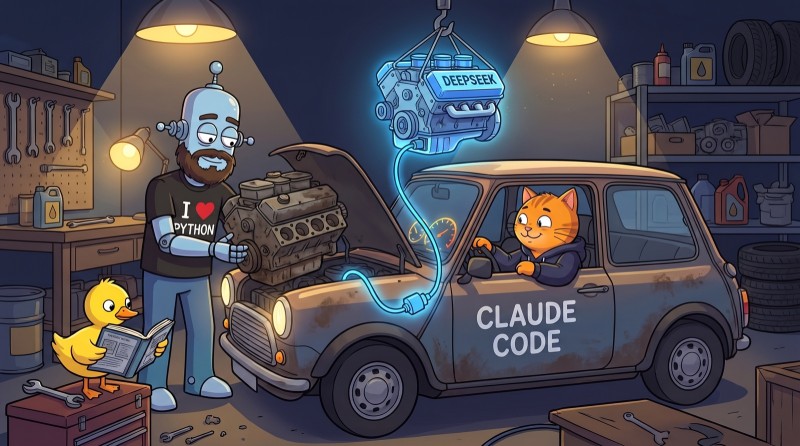
Three things to know in advance:
- This isn't a configuration Anthropic officially supports. The Chinese providers document it themselves. Some things may behave differently: for example, Chinese models won't show up in the
/modelmenu, and you can check which model is answering with/status. - Watch the
ANTHROPIC_API_KEYvariable. If it's still set in your environment, it can override the provider key, and your requests will silently go to Anthropic at full price. - Quality will be different. Claude Code is tuned for Claude models. On simple tasks the difference is barely noticeable; on long agentic sessions it is.
We covered how the agent itself, skills, subagents, and hooks work in detail in How AI Agents Work.
The catch
The hype-filled reviews usually stop here. We don't. Here are four things worth understanding before you move your work to a Chinese model.
1. "Run it yourself" doesn't mean on your laptop
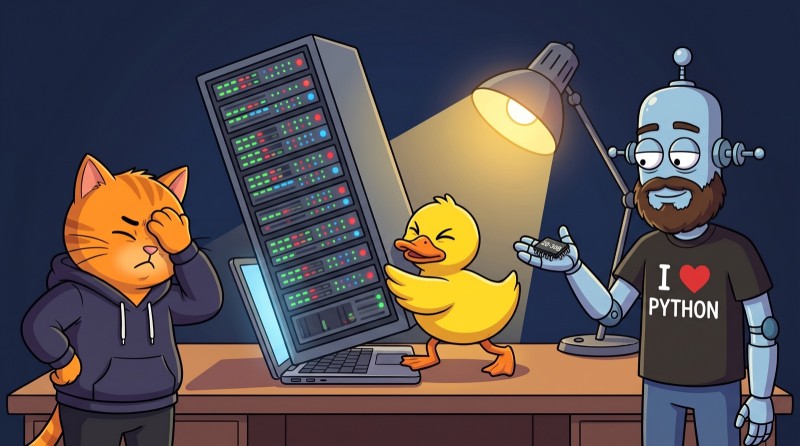
Reviews love to say Chinese models can run through Ollama or LM Studio right on your computer. Technically, yes. In practice, only the small versions. The GLM-5.1 flagship has about 744 billion parameters; Kimi K3 has 2.8 trillion. To run that, you don't need a laptop — you need a server rack with several expensive GPUs.
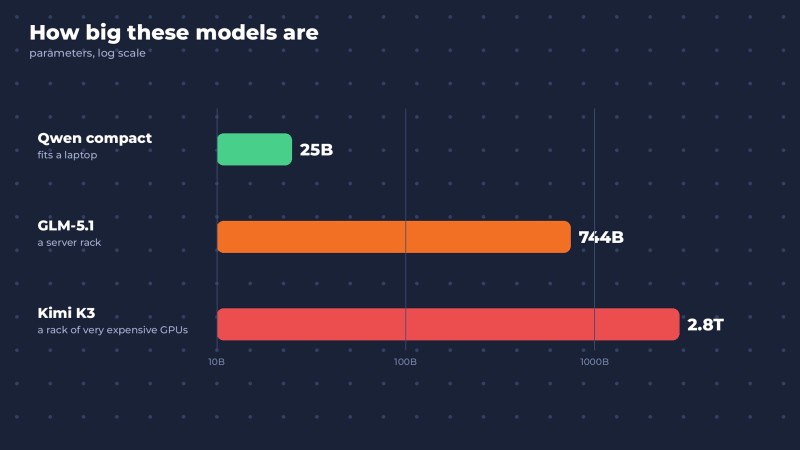
What realistically runs on a regular computer are compact distilled models — for example, smaller Qwen versions with 20–30 billion parameters. They're useful, but they don't reach flagship level.
2. Where your data goes
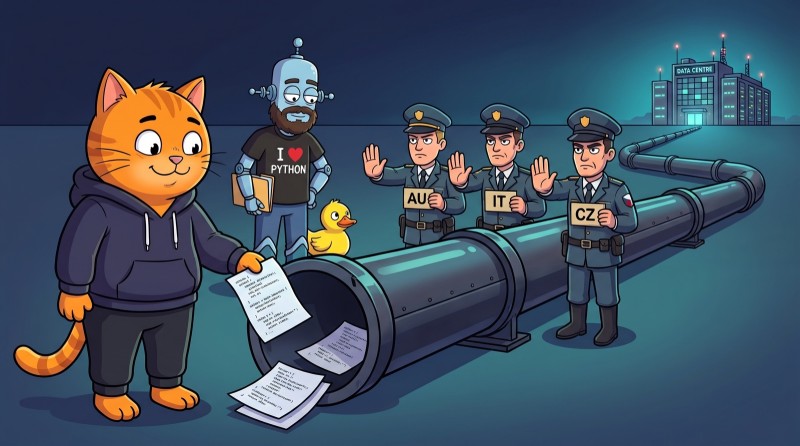
An open model on your own server is one thing. A Chinese company's cloud API is something else entirely. DeepSeek's privacy policy states plainly that prompts and uploaded files are stored on servers in China. That's why Australia banned DeepSeek on government devices, Italy's regulator moved to pull the app from app stores, and the Czech Republic and Taiwan banned it in government agencies.
A practical rule: a personal side project through a Chinese API — go ahead. Your company's code, keys, and client data — only through a local deployment or a Western provider that hosts the open weights itself. Same weights, but the data stays under your control.
3. AI slop is still a thing
A cheap model makes mistakes no less often than an expensive one, and sometimes more. On complex logic and long agentic tasks, Chinese models are noticeably more likely to confidently output broken code or invent methods that don't exist. Benchmarks published by the companies themselves deserve a healthy discount: they measure what's convenient to measure.
4. "Open" doesn't mean "do whatever you want"
MIT and Apache 2.0 are genuinely permissive licenses. Kimi K3, however, has its own license with conditions for large commercial providers. Before building a product on a model, spend ten minutes reading the license. It's cheaper than redesigning your architecture later.
What this means for developers
There's an old idea we keep coming back to: tools reset to zero, fundamentals stay. Chinese models show this more clearly than anything.
A year ago, access to a strong model was an advantage. Now you can get a flagship-level model for free, and in a month the next one will come out — also for free. Models are becoming a commodity, like electricity. Nobody brags that their outlet has power.
The value shifts to whoever knows how to use that power. Pick a model for the task and the budget. Connect it to an agent. Check what it wrote — and catch where it was confidently wrong. Set up permissions so the agent doesn't wreck anything. That's the skill people pay for. And it doesn't lose value when the next model comes out — it gains value.

The best model isn't the one at the top of the benchmark. It's the one whose output you know how to verify.
Where to learn this
Working with agents in a way that doesn't depend on any single model is exactly what our Building with Claude Code course from AI Academy is about. 16 levels and 200+ tasks: permissions and context, skills, subagents, MCP, hooks, plan mode, and keeping control through git. It all works the same no matter which model is under the hood.
And if you're just getting into code, start with the fundamentals: to verify what a model writes, you need to read code yourself. Our Python course builds exactly that, with thousands of tasks and instant checks.
FAQ
What are the best Chinese AI models in 2026? As of late October 2026, the main ones are DeepSeek V4 (the cheapest API), Alibaba's Qwen 3.8 (the most popular open model), Moonshot AI's Kimi K3 (agentic coding and large repositories), Z.ai's GLM-5 line (coding, working in Claude Code), and MiniMax M3 (a million-token context and multimodality). For images and video: ByteDance's Seedream 5.0 and Seedance 2.0.
Can Chinese AI models replace ChatGPT and Claude? For many tasks, yes: automation, document processing, moderately complex code generation. On complex logic and long agentic scenarios, Chinese models still make mistakes more often. Their main advantages are API prices tens of times lower and the ability to run the model on your own server.
How much do Chinese AI model APIs cost? DeepSeek V4.1 Flash costs from $0.15 per million input tokens and $0.60 per million output tokens. Kimi K3 costs $3 and $15. For comparison: Claude Sonnet 5.5 costs $2 and $10, GPT-5.5 costs $5 and $30. Prices change often, so check the providers' official pricing pages.
Can I run a Chinese AI model on my own computer? Only compact versions — for example, smaller Qwen models with 20–30 billion parameters through Ollama or LM Studio. Flagships like GLM-5.1 (about 744 billion parameters) or Kimi K3 (2.8 trillion) require server hardware with several powerful GPUs.
Is it safe to send code to Chinese AI models? Through a cloud API, with caution: DeepSeek, for example, stores prompts and files on servers in China, which is why several countries have banned it on government devices. For work code and client data, it's safer to run open weights locally or through a Western provider that hosts them itself.
How do I use DeepSeek or Kimi with Claude Code? Through environment variables: set ANTHROPIC_BASE_URL to the provider's Anthropic-compatible address (for example, https://api.deepseek.com/anthropic), the provider key in ANTHROPIC_AUTH_TOKEN, and the model name in ANTHROPIC_MODEL. It's a configuration documented by the providers but not officially supported by Anthropic.
GO TO FULL VERSION