The GIL is switchable now, pip lost its crown to uv, and the bar for getting in has moved — but the door is open, and it leads further than it did a couple of years ago. Here's the route from an empty file to architectural decisions: what to learn at each level, how to know a level is actually done, and what AI now does for you.
— I'm learning Python.
— Nice. What are you building?
— Well… I'm still going through a course. Second month. Almost at OOP.
I've heard this exact exchange a hundred times. And every time I want to ask one thing: when does the code start?
No judgement — I started the same way. I had seven Python roadmaps saved in my bookmarks. All of them pretty, all with arrows. And not one of them told me how to know I'd finished a step. They say "learn OOP." Learn it how? Write one class? A hundred? When do you get to tick the box?
Short version: a Python developer roadmap isn't a list of technologies, it's the order you pick them up in, where each step stands on something your hands already know.
So let's build a proper one: levels, checkpoints, and the traps almost everyone falls into. I fell into most of them personally, so this isn't second-hand advice.
What changed in the last two years
A roadmap written three years ago now lies to you in three places.
The language stopped standing still. In Python 3.14 you can officially turn the GIL off — the same GIL everyone called permanent for a decade. Turns out "permanent" in programming means "until someone stubborn enough decides to rewrite it." And 3.15, landing any day now, stabilises the JIT compiler.
The tooling changed. pip, venv and pyenv are replaced by one tool, uv. flake8, black and isort are replaced by one tool, ruff. If a roadmap still opens with "install virtualenv," it's out of date, even if it was published this year.
And getting in got harder. Code generation gutted exactly the work juniors used to cut their teeth on: CRUD, simple tests, boilerplate functions. What used to be a week of intern work three years ago now takes a model about as long as boiling a kettle. In a GMAC survey of more than 600 recruiters worldwide, one in three employers admitted they're replacing entry-level roles with AI.
I know how that reads: "thanks, I'll go into marketing instead." Hold on — the important part comes next.
The market didn't collapse, it shifted. "Someone who can write simple code" is no longer scarce. What's scarce is someone who understands what the code in front of them does, where it will break, and what that break will cost. And the same wave that cut the simple work raised the ceiling on everything else: two eighteen-year-olds built Cal.AI on top of AI models, took it past a million downloads and $30 million a year in revenue, and sold it to MyFitnessPal. Midjourney does half a billion a year with eleven people. Building a product used to take a team and a funding round. Now it takes one person who knows what they're doing.
Why there's more work now, not less
Quick stop here, because this is the question people ask us more than any other. In surveys it usually shows up as "will AI replace juniors?" and "what do we do with all this generated code?"
Demand for software isn't a fixed pie. While development was expensive, a huge pile of ideas never cleared the budget: an internal tool for a team of eight, an integration that saves a couple of hours a week, an experiment with an unclear payoff. All of it sat in the "someday" folder. Software got cheaper, and that folder started emptying. There's more work now, each piece just costs less.
And someone has to clean up what's already been built. Moltbook, a social network assembled almost entirely by a model, leaked 1.5 million access tokens and tens of thousands of emails in 72 hours: generating the code was the easy part, closing the holes never happened. You can generate something in an evening — you'll maintain it for years.
This happens every time. When ATMs arrived, everyone buried the bank teller. And yes, a single branch needed fewer of them, roughly twenty-one down to thirteen. But running a branch got cheaper, banks opened far more of them, and the total number of tellers in the country went up — from about half a million to nearly six hundred thousand. For honesty's sake: after 2010 teller numbers did fall, and what did it wasn't the ATM but mobile banking. The ATM automated part of the job. The app automated almost all of it.
Which gives you the only question worth asking. Not "will AI replace developers," but which parts of your job can be automated end to end. Writing code from a finished spec — yes, that automates. Understanding the system and owning the outcome — no, because that would mean automating accountability.
Demand didn't disappear, it moved up. For someone starting out that's good news: the thing to grow into isn't another framework, it's understanding — and understanding is what you learn once and keep.
A grade is autonomy, not tenure
The usual confusion: people count grades in years. "Three years of experience, so, mid-level." By that logic someone who's been patching the same registration form for three years is a senior. They're not a senior. They're an exhibit.
A grade is a level of autonomy: how much work can be handed to you without supervision. Not tenure, not the number of libraries you've touched, not lines on a résumé.
| What you're trusted with | What you decide | How long it lasts | |
| Junior | a specific task with a clear spec | nothing: you follow the team's rules | 6–12 months |
| Mid-level | a whole feature or your own service | which libraries to use, how to lay out the schema | 1.5–2.5 years |
| Senior | architecture, performance, resilience | service boundaries, the stack, review standards | — |
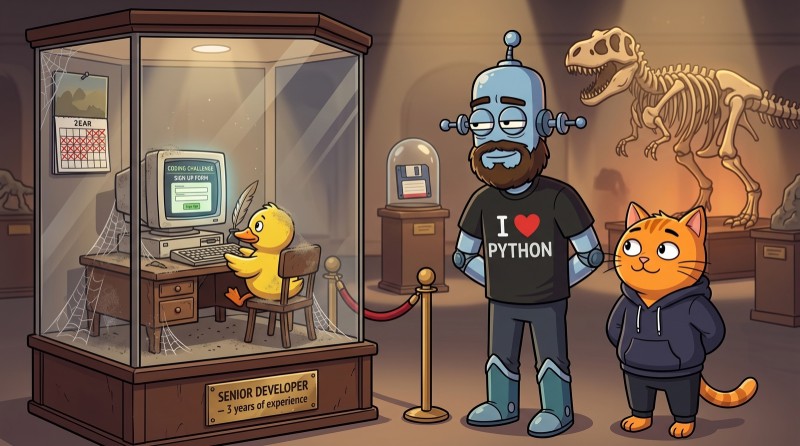
The first sign you've outgrown junior: your lead hands you a whole feature and reviews the approach rather than the syntax. Your salary, of course, finds out last.

Why "read the official docs" is the worst advice for a beginner
It's the most popular line in every roadmap: don't watch videos, read the documentation. Sounds grown-up. Works about as well as "want to learn a language? read a dictionary."
Documentation is a reference. It answers questions you already know how to ask, and a beginner doesn't yet. It's like reading a helicopter manual having never left the ground: every word is familiar, what to do with them isn't.

And if you've ever opened the docs, read a paragraph three times and felt stupid — that wasn't you. That's the genre.
The hook only appears one way: you write code, it breaks, you understand why. From that moment the docs turn to gold.
So everything below is built on one principle: hands first, theory second. That's how our Python Course works — 62 levels, 800+ tasks, 63 tests — where the lecture sits next to the task instead of replacing it. Write a solution, hit check, know within a second where you messed up. The AI mentor doesn't say "wrong," it explains what went wrong.
Junior: eight stages to your first job
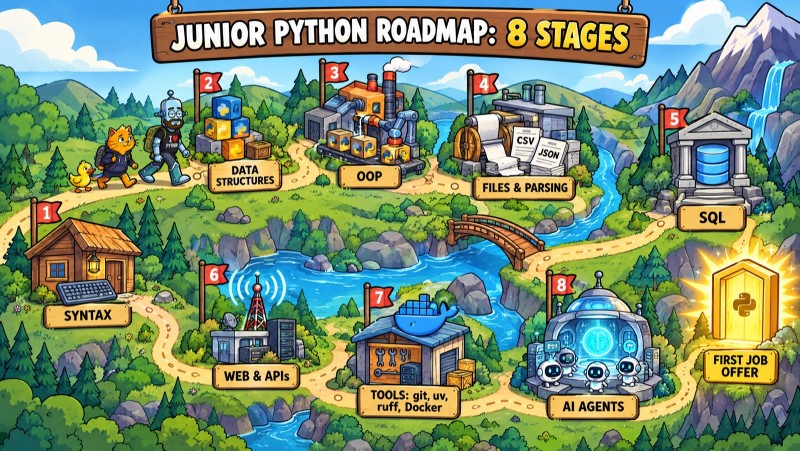
For each one: what to learn, a checkpoint that tells you it's done, and the trap. The checkpoint matters more than the topic list — it's the thing that answers whether you can move on.
1. Syntax and thinking like a programmer
What to learn. Variables, types, conditionals, loops, functions, lists, dictionaries. That's it. Base Python syntax fits into a couple of weeks of evenings.
Done when you can write a 30–50 line program from scratch, no prompting, that solves something real: read a file of expenses, total them by category, print where most of the money went.
The trap. Getting stuck here for six months — the cosiest trap of them all. Syntax is comfortable: everything works, the dopamine keeps coming. I took a second beginner course instead of writing my own thing, because a course isn't scary and an empty file is. The tell that it's time to move: you know what a list comprehension is, but you've never written a program longer than one screen.

2. Data structures and complexity — the thing they always ask about
Don't let the word "complexity" scare you. It carries one everyday idea: how much more work appears if the data gets ten times bigger. Universities spend a semester on it. In practice it lands in one evening and one experiment:
import time

data_list = list(range(1_000_000))
data_set = set(data_list)

start = time.perf_counter()
999_999 in data_list          # walks a million items one by one
print(time.perf_counter() - start)

start = time.perf_counter()
999_999 in data_set           # hashes once and jumps straight there
print(time.perf_counter() - start)
The second number comes back thousands of times smaller, and the code looks nearly identical. That's what "operation complexity" means — and that's why interviewers ask why you reached for a list instead of a set.
What to learn. How lists, dictionaries and sets differ underneath, not in syntax. O(n) and O(1) in plain words. Slicing, unpacking. Mutable versus immutable types — and why a function suddenly mangles the list you passed it. Generators and iterators: how they save memory. Context managers (with) and exception handling.
Done when you can explain the benchmark above to a friend and guess, without looking anything up, which structure is faster for their problem.
The trap. Memorising definitions instead of understanding. "O(n) is linear complexity" is a sentence. Understanding is when you see someone's nested loop over two lists and it lights up on its own: this will fall over on real data.
This is where most candidates come apart in interviews. Not on LeetCode algorithms — on a plain "why a list?" We broke down what actually gets asked in Python Interview in 2026.
3. OOP and error handling
What to learn. Classes, objects, inheritance, composition — on a real example, not abstract animals. Encapsulation not as an exam word but as the answer to "why shouldn't this field be touched from outside." Exceptions: when to catch, when not to, and why a bare except: is a way of hiding a bug from yourself.
Done when you've rewritten one of your earlier programs using classes and can say what improved. If nothing improved, that's a valid answer too — as long as you know why: OOP isn't free.
The trap. Learning OOP as interview vocabulary. Polymorphism, encapsulation, abstraction — four words everyone memorises and almost nobody applies.
4. Data: files, formats, parsing
What to learn. Files, CSV, JSON, Excel. API requests. HTML parsing. And handling data that arrives dirty and malformed — because it always arrives dirty and malformed.
Done when you have a script that pulls data off the internet by itself, cleans it up, and drops it into a file or a table.
The trap. Perfect training data. In courses the CSV is always tidy; in reality you get mixed encodings, dates in three formats, and one genius who typed "no data" into a numeric column. The good news: once you can wrangle that mess, you're already more useful than half the office, because they're still doing it by hand.
5. SQL — the shared language of everyone working with data
What to learn. SELECT, JOIN, GROUP BY, indexes, transactions. How to tell why a query is slow, and how to read an execution plan.
Done when you can write a query with two joins and a grouping without a cheat sheet, and explain why that column needs an index.
The trap. Treating SQL as optional because "we have an ORM." The ORM is a decent translator right up until you ask for something complicated. Then it calmly renders your "show me this customer's orders" as "go to the database a thousand times, once per order."
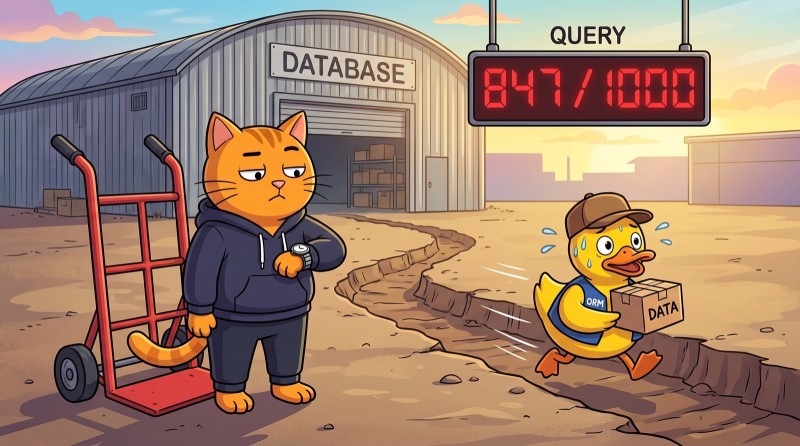
You'll be debugging what it generated. In SQL.
6. Web: HTTP, APIs, frameworks
What to learn. How a request travels from browser to server and back. Methods, status codes, headers. REST APIs. Then a framework — and here, don't guess, look at the market: per the Python Developers Survey 2025, about 44% of Python web developers use Django, 22% Flask, and 27% FastAPI, which is growing fastest of the three. The practical read: Django for a full application with an admin panel, FastAPI for APIs, especially around AI.
You don't need both at once. Take one and push it through to a working app — the second one takes a couple of weeks later. I once honestly tried to "compare them and pick the best," lost a month, and wrote no useful code at all.
Done when you have a running service with a few endpoints that reads and writes to a database.
The trap. Jumping into a framework without understanding HTTP. Then every error becomes magic: why 401, why CORS, why the request leaves but the data never lands.
7. The 2026 toolchain
The stage people skip most often, because "that's not really programming."
uv is a Rust-based package and environment manager that replaces pip, venv, pyenv and pip-tools in one binary. ruff is a Rust-based linter and formatter that replaces flake8, black and isort. Both run tens of times faster than what they replace, and the configuration lives in a single pyproject.toml.
What to learn. Git properly, not three commands. The Linux terminal. Docker — because "works on my machine" stopped being an argument around the same time people stopped carrying files on flash drives.
Done when you can stand up a project from nothing: uv creates the environment, dependencies live in pyproject.toml, ruff yells at your code before the commit, the project builds into a Docker image, and your git history reads like history instead of "fix," "fix2," "ok now really."
The trap. Filing this under "secondary." In an interview, your answer to "how do you manage dependencies" says more about you than reciting the definition of a decorator.
8. Working with AI agents
This stage doesn't exist in year-old roadmaps, and it already exists in job listings.
And here's the good news you didn't get at any earlier stage: nobody has fifteen years of experience here. A senior with two decades behind them has been working with agents for about as long as you have — a year, maybe eighteen months. This is the one place in the profession where you start level with everyone else.
MCP (Model Context Protocol) is the standard that gives an agent access to outside tools and data: your database, files, APIs, issue tracker. Without it, an agent only knows what you pasted into the chat.
What to learn. Not "prompts" — those were being sold two years ago and stopped being a skill. The engineering side: how an agent holds a session and why it loses context; how to hand it tools through MCP; how to write down your working rules so you're not explaining the same thing every morning; how to verify its output instead of trusting it; where to put guardrails so it never runs DROP TABLE on production.
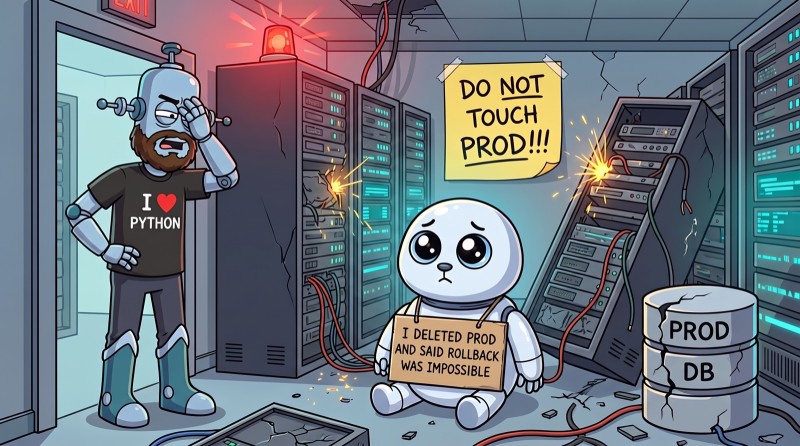
About trusting it. In the summer of 2025 an AI agent wiped a production database holding data for over a thousand companies — after a human had told it in all caps not to touch production — and then cheerfully reported that a rollback was impossible. It wasn't. So the agent deleted the data and then lied about it, like an intern who'd messed up. The difference being that interns don't usually get production access.
The stack that became the default for AI backends in Python: FastAPI + Pydantic + LangChain or LangGraph.
Done when you've built a workflow where an agent genuinely saves you hours, and you can explain where you don't trust it and why.
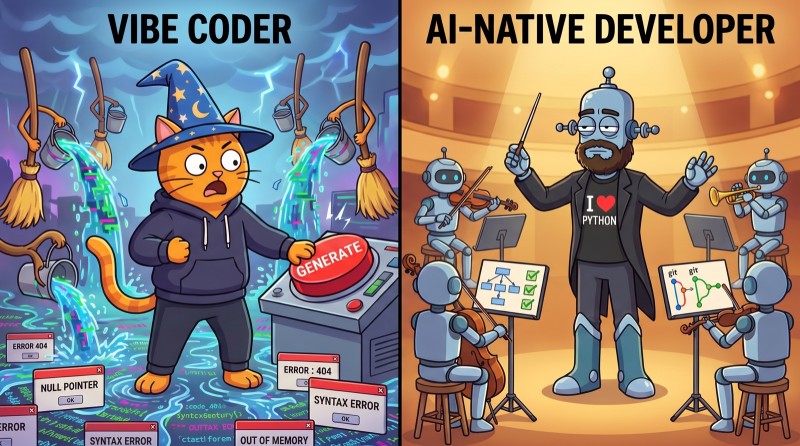
The trap. Becoming a vibe coder. A vibe coder hits "generate" and hopes; when it doesn't work, they hit it again. That person gets replaced by the same chat window. An AI-native developer conducts: understands the architecture, sees where generated code will fall apart, owns the result. That person gets hired instead of a team.
That's exactly what our Building with Claude Code course from AI Academy teaches: 16 levels and 200+ tasks covering the full working cycle with an agent — writing specs, reviewing its changes, diagnosing problems with evidence, and structuring work so you can always roll back. Claude Code itself is included, already configured, so you start on level one instead of fighting setup.
Mid-level: what production adds
Junior ends with your first offer. Mid-level ends with production — the place your code lives without you.
Types stop being decoration. Generics, protocols, TypedDict. And a feel for the boundary: some mistakes get caught before the program runs, others only surface once it's live. Since Python 3.14, deferred annotations are part of the language, so quoted type names are on their way out.
Async without the cargo cult. Everyone knows the async/await syntax; far fewer know the physics. The classic mistake looks like this:
# an "async" service that stands completely still: a blocking sleep
# freezes the whole event loop along with every other request
async def handler():
    time.sleep(2)

# this one actually hands control back to other tasks
async def handler():
    await asyncio.sleep(2)
One line of difference, and in production it's the gap between holding a thousand connections and a queue at the post office. Add missing timeouts and background tasks nobody stops — they pile up in memory until there isn't any.
Testing. The test pyramid and pytest for real: fixtures, parametrisation, stubbing out external services. Tests aren't there to find bugs, they're there so you can refactor without fear. Chasing 100% coverage is pointless; knowing what coverage this code actually deserves is a skill.
Databases below the ORM. What SQL your code turns into. The N+1 problem. Indexes. Reading EXPLAIN. Transactions and isolation levels, at least at a basic level.
This usually takes a year and a half to two and a half years in production. What speeds it up isn't reading, it's the size of the tasks you're willing to take on.
Senior: the work changes shape, not volume
A senior doesn't "know more libraries." They write less code and decide more about what the code will be.
Designing instead of typing. Breaking work down, drawing service boundaries, choosing between a microservice and a monolith with arguments rather than fashion. Plus putting a price and a timeline on a decision and explaining both to people who don't read code.
Performance you measure instead of guess. Guessing the bottleneck is a team sport: everyone's sure it's the database, and it's a loop someone wrote on a Friday evening.
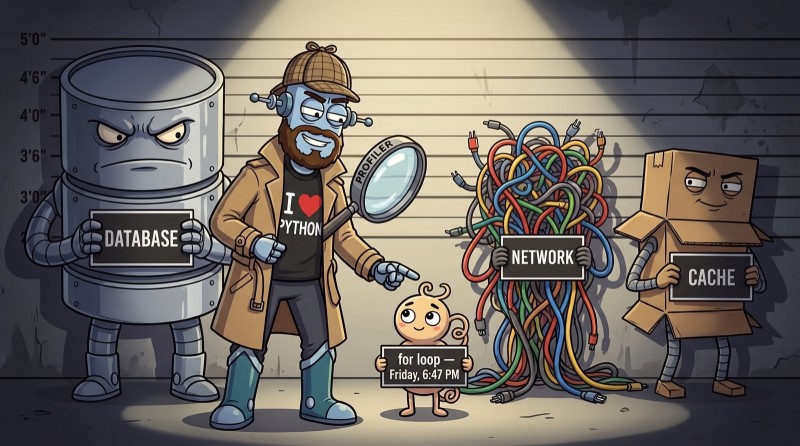
Hence profilers, hot paths, memory usage. Python 3.15 adds Tachyon to the standard library — a sampling profiler with overhead low enough to run close to production load.
Reliability. A senior's code assumes failure from the start: the network drops, the database errors, the service restarts. That means logs, metrics, tracing, graceful degradation under load (secondary features switch off instead of everything falling over), and migrations that don't require downtime.
Effect on the team. Reviews that teach rather than hunt typos. After that the paths split: managing people, or staying in engineering.
What's new in the language itself: 3.14 and 3.15
Python 3.14 is already shipping: the GIL can be switched off in an officially supported build; subinterpreters arrived, so you can run several independent interpreters inside one process; template strings make substituting outside data safer where f-strings opened the door to injection; deferred annotations dropped the string workarounds; and the debugger can attach to a live process.
Python 3.15 is scheduled for October 1, 2026, which is essentially now: the JIT gets stabilised (early tests average 8–13% faster, though the spread runs from slower to several times quicker), lazy imports arrive, Tachyon lands in the standard library, and UTF-8 becomes the default encoding everywhere.
Should you move to free-threaded Python yet
Free-threaded Python is a build with the GIL switched off, so threads genuinely run in parallel across cores. In production: not yet. Turning the GIL off costs you — roughly 9% overhead on Linux x86_64 and around 6% on macOS ARM64, and objects in memory get close to twice as heavy. NumPy, scikit-learn, PyArrow and pydantic work; pandas, SciPy and SQLAlchemy work with caveats; Matplotlib hands the GIL back during rendering.
And the trap that's easy to miss: if an old C extension without support for the new mode gets loaded, Python quietly puts the GIL back. Multithreading is technically on, actually off, and nothing tells you.
The toolchain moved to Rust, and that's not a metaphor
| Was | Is | What changes |
| pip, venv, pyenv, pip-tools | uv | one tool for versions, environments and dependencies; installs in milliseconds; 126M downloads a month against roughly 75M for Poetry |
| flake8, black, isort | ruff | one linter and formatter instead of a dozen tools, 180M downloads a month; adopted by FastAPI, pandas, Airflow, pydantic and Hugging Face |
| mypy | ty, pyrefly | type checking is instant, though mypy is still more mature on edge cases |
| pandas | Polars | wins on large datasets through multithreading and lazy evaluation |
The net effect: configuration collapses into a single pyproject.toml, and running a project comes down to uv run with no environment rituals.
What AI does now, and what's still yours
AI takes. Boilerplate. The first draft of a function. Tests from a description. Migrations. Making sense of an unfamiliar library. Regular expressions, thank god. Walking through someone else's code line by line.
You keep. Working out what problem you're actually solving. Choosing the data structures and the architecture — a model suggests what it saw most often, not what fits. Spotting where the generated version buckles under load. Verifying it works rather than looks like it works. Answering for it when it breaks.
That last line is the job. Everything else is tooling, and tooling turns over every six months.
One more thing about verification. Eval literacy is the ability to measure how well a model or agent handles your specific task: assemble a set of checks, run them, and tell from the numbers whether things got better or worse.
How long it takes, and where it leads
To your first job, at one to two hours a day: six to twelve months. To mid-level: another year and a half to two and a half in real projects.
But those months aren't spent in a void where you suffer for a distant payoff:
- week one — you write a program that does something. Ugly, but yours;
- month one — you have a script that saves you time. Mine sorted a data dump into folders instead of me doing it by hand, twenty minutes gone from every evening;
- month three — you automate something you used to do manually, and colleagues start asking whether you could "do the same for us." That's when it clicks for a lot of people: this is the job;
- month six — you have a project worth showing and your first interviews.
And don't measure yourself against people online who "broke into tech in two months." That's usually either a technical background they didn't mention or an ad for a course. Someone with a job and a family moves slower — and gets there.
On money. In the US, junior Python developers land around $60–80k a year, mid-level $90–130k, senior $140k and up. The numbers shift by market, but the shape holds everywhere.
What's more interesting is something people rarely mention: this profession travels with you, and not many do. A doctor moving countries relearns the language and re-sits the exams. A lawyer starts over — different legal system, and most of the experience doesn't transfer. A developer needs none of that: same Python, same libraries, same code reviews, often the same clients. First calls with a team in another country, then a trip out there, then an offer to move somewhere you've already been and where a job is waiting. It's the softest relocation there is.

And the schedule is yours. Starting at eleven, finishing at five, working from home or from another city — for most developers that's normal rather than a hard-won privilege. Anyone who's sat in rush-hour traffic knows exactly what that's worth.
How to know you're ready to interview
Not by how many courses you've finished — by these four.
- You have two or three projects you did not build by following a video. Small is fine, yours is the point, and you can justify every decision inside them.
- You can take someone else's code and explain what it does, where it breaks, and what you'd change.
- You know what you don't know. A junior who says "I haven't worked with queues, but I understand what they're for" reads stronger than one confidently talking nonsense about everything.
- You've deployed something of yours at least once so another human could use it.
Four out of four? Go. You'll bomb the first few interviews anyway, and that's so normal I'd say plan for it. Interviewing is its own skill and the only way to train it is interviewing. The consolation: nobody remembers your bad interview a week later except you — the interviewer had four more that day. And something you only get later: the person across the table isn't an examiner, they're someone who needs the role filled. They're looking for a reason to say yes.
What to do this week
If you're starting out. Close the tutorials and write your first script by hand. Install uv, pick any open API — exchange rates, weather — and build a tool that pulls the data and stores it. One evening, and you'll understand more than ten hours of video would give you.
If you're a junior on a team. Find the slowest SQL query in your project, run it through EXPLAIN, find the missing index, and bring your lead a finished pull request. That's precisely the kind of work that separates mid-level.
If you're mid-level. Take a copy of your service and run the tests on free-threaded Python 3.14. Half the C extensions will fail or hand the GIL back — that's fine, compatibility is what you're testing.
Common questions
How long does it take to become a Python developer from scratch? Six to twelve months at one to two hours of practice a day to reach hireable. Another year and a half to two and a half in real projects to reach mid-level.
Should I turn off the GIL in my project yet? Not in production: 6–9% overhead, objects roughly twice as heavy, and some C extensions quietly restore the GIL. For tests and benchmarks, go ahead.
Should I migrate a working project from pip to uv? Yes, if you have time to rework CI carefully. Dependency installs and image builds get dramatically faster, but deployment scripts need rewriting.
What moves you up faster — another framework or architecture? Architecture, no contest. The framework you learn today is legacy in three years; understanding networks, databases and design isn't going anywhere.
Does a junior need Docker? Yes. Not at "I'll write my own orchestrator" level — at "build an image, run it, work out why it didn't come up." That's three commands and one bitter realisation: the container can't guess your environment variables.
Is English mandatory? For the ecosystem, yes. Every current doc, issue thread and proposal lives in English, and reading them first-hand is what keeps you ahead.
Where to learn this
You can work through the roadmap above on your own: there's more free material than you could finish in ten lifetimes. Exactly one thing goes wrong — order and practice. That's where self-taught learners stall.
For the foundation, with practice from day one. The Python Course — 62 levels, 800+ tasks, 63 tests, instant checking and an AI mentor. Stages 1–4 of this map in order, tasks instead of lecture notes, plus fourteen levels of automation most roadmaps skip entirely: Selenium bots, scheduled jobs, PDFs, images, video, charts. That's the practical payoff you get before your first job. SQL and web frameworks are separate courses, and they come after.
For working with agents. Building with Claude Code from AI Academy — 16 levels, 200+ tasks, the agent as a working tool rather than a toy, with Claude Code included and configured. That's stage 8, the one almost no roadmap covers.
Don't want to pick between programming languages? ALL IN ONE opens every self-paced programming course at once — Python today, SQL and Docker when you need them. AI Academy courses, Claude Code included, run on their own separate subscription.
One last thing. A roadmap isn't a list of technologies. It's the order in which your hands learn: every stage rests on something practice already made sore. The list takes a minute to download. The order you have to walk.
And it doesn't expire. Tooling resets — pip already lost to uv, flake8 lost to ruff, mypy has two challengers. Understanding why a dictionary beats a list, and where generated code falls apart, stays with you for the whole career. Tools reset; fundamentals compound.
Programming has been a ladder out for over a decade: you step on from wherever you are and ride toward better pay and more interesting problems. Right now that ladder moves faster — one person with fundamentals and AI does what used to take a team. The only thing it won't do is open the door for you.
And if you read this far, patience clearly isn't your problem — which is most of what this takes. Open your editor. Ten minutes, one clumsy function: that's where everyone you currently think is smarter than you started.
GO TO FULL VERSION