
Why do programmers constantly walk around looking so happy? The answer is simple and disarming: because they work at a job they love and they have a ton of money.
Welcome to the world of programmers.
Programmer salary
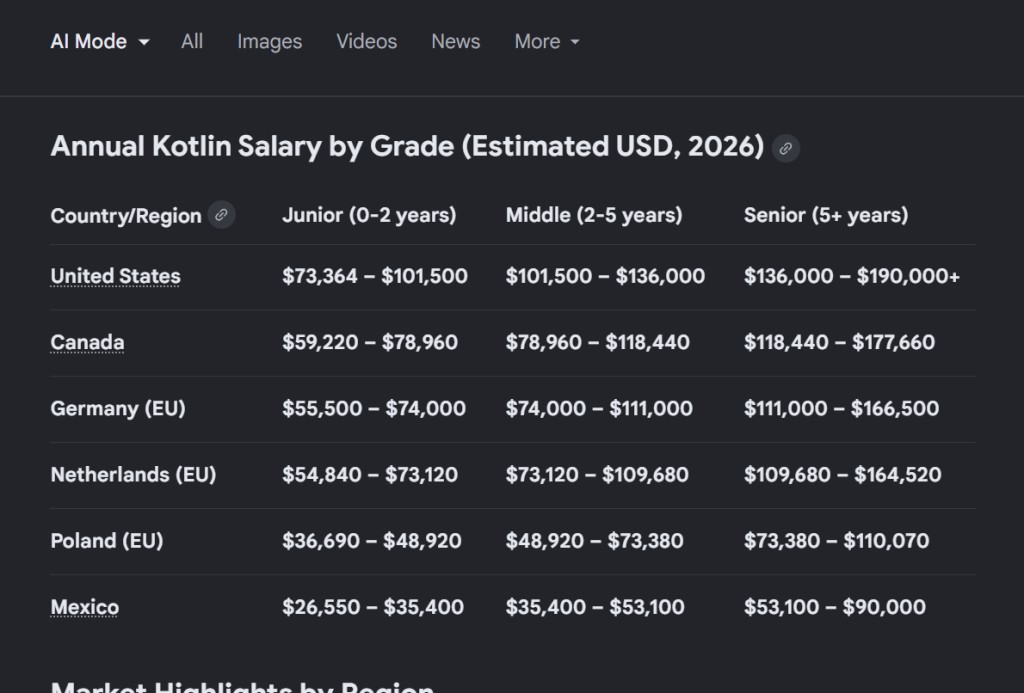
I want to talk about programmers’ salaries: what things actually look like with pay, where it’s better to work and where it’s not. If you’re not a programmer and try to figure this topic out on your own, you may end up with a set of very contradictory data.
The thing is that the main factor affecting a programmer’s salary is not their qualification but their workplace. Sometimes, with the same qualification, the difference between a good and a bad place can reach 2–10×(!)
At any specific moment in time, your qualification is constant. You can’t become twice as experienced in a month and get paid twice as much. But you absolutely can change jobs within a month and get paid twice as much. So let’s find out where it’s best to work.
Here are three factors that strongly affect salary levels at companies:
1) Whether software development is the company’s core business.
2) Whether the company targets the international market or the domestic one.
3) Whether the firm is owned by a Western company or a local one.
Note that the city you live in does not play a decisive role. That is, if you earn 10× less living in Dresden than your acquaintance in New York, that means the factors listed above have come into play.
Specific numbers
It’s hard to provide specific numbers for the whole world. Let’s describe the situation in Eastern Europe, which is generally true for all countries where IT outsourcing/outstaffing is more or less developed.
Here is how much a Java Senior Developer with five years of work experience can earn, depending on the level of the company they work at:
| Level | Monthly salary | Description |
|---|---|---|
| 1 | $200 — $500 | At the very bottom are companies where IT is not the company’s core line of business, the customer is the domestic market, and the owner is the government. For example, an IT department in the tax office or another government organization. |
| 2 | $500 — $1500 | Below average are IT departments of various non-government organizations: banks, etc. |
| 3 | $1,000 — $2,500 | Mid-level are firms that develop software. |
| 4 | $3,000 — $4,000 | Above average are firms that develop software and whose customers are in the West. |
| 5 | $4,000 — $5,000 | At the very top are firms that develop software, whose customers are in the West, and whose owner is also Western. There aren’t many of them. Open positions don’t appear often, and getting in isn’t easy. But they exist. |


What is the strangest thing about the current situation?
Half of all programmers work at level 1 and 2 companies.
Want to know what the catch is?
There are hundreds of open programmer positions at level 3 and 4 firms. These companies are ready to offer higher salaries and usually much better working conditions.
A real-life situation: there are two Java Juniors. One goes to work for $100 a month (at a level 1 firm), and the other for $1,000 a month (level 4). Why get less?
What you can achieve if you don’t waste time
If you constantly engage in self-development in programming, your salary, starting today, will change approximately like this (+/- a few hundred dollars depending on the city where you work):
Plan
0–3 months (Student)
You know very little about programming. Maybe you studied it at school and/or university, but very superficially.
Your task is to learn programming and study Java.
Your goal is to get a job as a Java Junior at a company of at least level 3.
During the first three months on the plan, you don’t get anything, because you’re simply studying programming. In the future, when you have a family and a bunch of loans, changing your specialization will be much harder. To fix a mistake, you’ll need to set aside money for a year of normal living. Don’t make stupid mistakes.
3–15 months (Java Junior Developer)
You are already working as a programmer, and your experience grows every day. Don’t slack off. You still have a lot to do before you can rest on your laurels.
Your task is to study the technologies you will need as a Middle developer. Which technologies exactly? The world changes. We can give advice now, and life will change everything. Find a few job postings online and see what they require. Be sure to read Bruce Eckel’s book “Thinking in Java”.
Your goal in the first year working as a Java Junior is to grow to the Java Middle level. Nobody says it’s very easy, but it’s quite possible for a goal-oriented person. This will immediately bump your pay up to about $1,500.

Year 2 working as a programmer (Java Middle Developer, level 1)
You worked hard last year, and now you’re a Java Middle Developer. With a salary of $1,500 you can live just fine. At work you’re given serious tasks, and your experience grows rapidly. You’ll grow into a Java Senior Developer in two or three years. There’s no point in rushing this process. You won’t get a huge salary increase anyway.
Your task is to learn design patterns and read McConnell’s “Code Complete”. Improve your code quality and your teamwork skills. You can make it a rule to read one IT book per week. Then in a year you’ll be 50 books smarter than everyone else. Don’t put this off for later: you won’t have more free time. It’s quite likely you’ll start a family, or it will grow if you already have one.
Your goal is to choose several technologies in which you will specialize as a Senior developer. You can’t learn everything anyway. And being a guru in a narrow area is a good decision.
Year 3 working as a programmer (Java Middle Developer, level 2)
You’re already an experienced Middle developer and are thinking about becoming a Senior Developer. It’s nice and prestigious. Your salary exceeds $2,000 (figures for Kyiv). From this point on, demand for professionals like you exceeds supply. You can always get a job in a couple of days, and you’re unlikely to earn less than you do now—unless, of course, you do something stupid.
Your task is to continue studying the technologies you chose. Work better. Not for the employer—for yourself. Ask to be assigned to projects with promising technologies (such as Big Data, at the time this article was written). You’ll be spending 8 hours a day in the office anyway, so why not get a little more money for it and, much more importantly, the most valuable experience you’ll still need.
Your goal is to change jobs. A good team exists everywhere. You’ll encounter new projects and technologies. Don’t get attached to your chair too early. If you still work at a level 3 company, think about moving to level 4. Level 5, while very attractive, is still out of reach for now.
Year 4 working as a programmer (Java Senior Developer, level 1)
You’ve become a Senior developer. Congratulations. Maybe you became one undeservedly, and you feel it. Congratulations anyway. It doesn’t matter whether you deserve your position right now; what matters is that you become worthy of it in the future. Agree: it’s better to get a good job first and grow into it in a year than to grow into a good position and then wait another year for it.
I hope you didn’t forget my advice and read one book per week—now any student would envy your capabilities. Or rather, be ready to worship them. Think about it: you have a serious salary approaching $3,000. Most likely, you’re still young. The whole world is at your feet.
Your task is to review your chosen technologies one more time. Maybe you need to change your specialization. The world has changed, technologies have changed, and you’ve gained knowledge over the last two years. What you stop on now will be your choice for the next few years. It’s the perfect time to choose the technologies you love.
Your goal is to choose a direction in which you can continue developing. There are many of them; nobody will list all the options, but you need to make the choice right now. If today you slightly change your present, it will lead to big changes in your future.
Year 5 working as a programmer (Java Senior Developer, level 2)
You’ve decided on your future and are working to make your dream real. The right direction chosen, combined with the desire to move forward, and the result won’t keep you waiting. Congratulations. We’re glad there is one more happy person.
There is one wise truth. People often overestimate what can be achieved in one year and underestimate what can be achieved in five years. Look back five years. That’s how it is.
Your task is not to make stupid decisions and not to give in to laziness.
Your goal is to choose a direction and keep moving. Did you think this was the end? Remember your senior year of school. It’s not the end; it’s only the beginning.
Future specialization

You can develop as a technical specialist (top branch), as a manager (bottom branch), or as a hired professional/independent consultant (middle branch). It all depends on your preferences.
A programmer’s career
The profession of a programmer differs from other professions. Here there is no need to make a manager career in order to earn well. Situations are not uncommon where a senior programmer earns more than their manager boss. The more experience you gain, the more your relationship with management moves away from the “boss-worker” model toward something like “movie star and their manager”. Overfed, self-valuing programmers who know their price pick and choose among both projects and job openings. Good for them.
So what do you need to become such a high-class and globally in-demand programmer? You must have extensive experience with the newest and most in-demand technologies. How do you achieve that? The answer is below.

After you get your first job as a programmer, two things begin to happen to you that, oddly enough, are not always obvious.
1. You start rapidly gaining experience working on real projects. One year of experience working as a programmer can give you more knowledge and skills in your specialty than 5 years at university. Experience is such a significant indicator that IT job postings often say things like “Java programmer with three years of experience required”.
2. You study new technologies for 8 hours a day, and you are also generously paid for it. The significance of this factor is hard to overestimate. In some cases, the skills gained are so important that, to get them, you might work for free—or even pay extra. If you choose projects wisely, the programmer career waiting for you will be breathtaking.
But what exactly should you choose?
Often, if you don’t know which technologies will be useful to you, you start choosing technologies based on “like it, don’t like it” or “trendy, not trendy”. Then it’s just luck. So it’s better to know in advance where you want to end up.
There are many development paths for a programmer, so for simplicity let’s single out a few and describe our view of the situation. Don’t treat this scheme as a rigid position—rather as a simplified view of things intended to add at least some clarity.
The 200-year-old programmer.

If what you like most is programming, then your path is Senior Developer, then Tech Lead Developer, and architect. You can also just work as a programmer for 50 years. Often the salaries of senior programmers and tech leads exceed the salaries of their managers. Don’t miss out.
Manager. You’re lucky: you’re not like everyone else.
You switched to the enemy’s side. Just kidding. If you’ve discovered strong organizational abilities, then your path is Team Lead and then Project Manager. This will give you a chance to become a director and will help when starting your own business. That’s what you want, right?
Steal a tractor.
If you’ve managed to start a family and have children, you may want a quiet and comfortable life in a country with a stable economy. You’re thinking about relocating/immigrating to Canada, the US, Switzerland, or even Australia. You have great skills and an in-demand profession. You won’t have to start as a dishwasher. For example, you can start as a Senior Java Developer—quite possibly with a big salary. Not so bad.
See the whole world except Paris, and don’t die.
You don’t have a family yet, and you want to travel. Upwork is everything for you. Find a client, agree on rates—starting from $20/hour—grab a laptop and go. Your income should be enough to live normally in any country in the world. Why not start fulfilling your dream right now?
GO TO FULL VERSION