1. A bit of history
When the Internet Revolution was just beginning in the 1990s, nobody knew how to properly build internet services. All of their features immediately became available to users, which strongly distinguished this approach from classic software development.
The largest search engine of that time, the company Yahoo, decided to take a new path and adopt an approach from Hollywood — even their managers were called producers :) Not surprisingly, they didn’t succeed 🤷♂️

Since the Internet Revolution, dozens of different ways of developing software have been tested, and now the situation has stabilized. There are standard roles with standard responsibilities, standard processes, and standard software.
During the training you will learn everything you need to know to work in modern IT companies, with modern development tools. 🎓
2. The product team
A typical development team consists of:
- People who decide what functions and features the product should have
- Product Owner
- Business Analyst
- People who decide what the product will look like
- UI Designer
- UX Designer
- Developers who implement all of this
- Software Architect
- Backend Developer
- Frontend Developer
- Mobile Developer
- People who are responsible for the product’s quality
- QA Automation
- DevOps
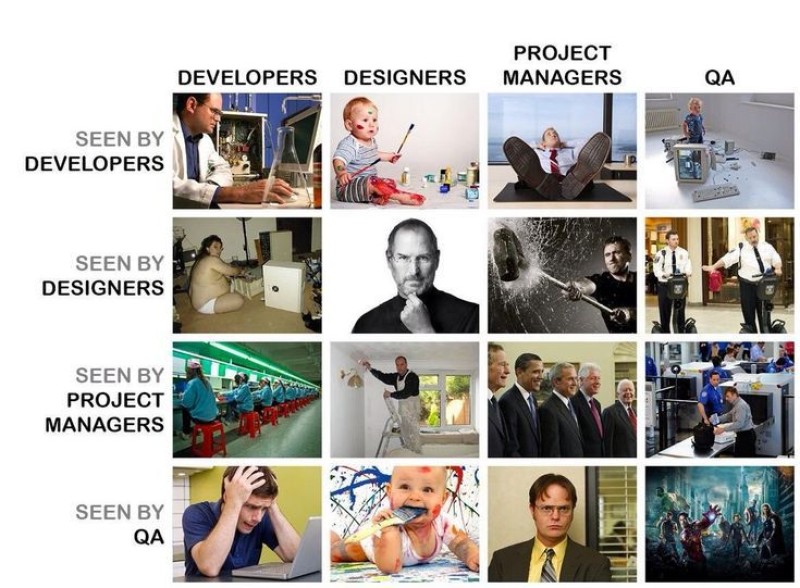
Product Owner plays a key role in software development by managing the product and ensuring that the development team focuses on the most important tasks. They define the product vision, compile and prioritize the task list (backlog), which helps ensure that each development stage aligns as closely as possible with business goals and user requirements.
UX Designer works on creating a convenient and effective product interface, which includes researching user needs, developing prototypes, and testing interfaces. This work is aimed at improving the user’s interaction with the product to make it as clear and user-friendly as possible.
DevOps specialists optimize software development processes and operational management to speed up and simplify the release of product updates. Their work includes automating testing, deployment, and system monitoring, as well as configuring infrastructure and ensuring continuous integration and delivery (CI/CD).
3. The development team
Development itself is carried out by programmers. They can be roughly divided into 5 categories:
- Software Architect
- Backend Developer
- Frontend Developer
- Mobile Developer
- Database Administrator
Roles and their scope can change depending on the team size and the specifics of the product, but the situation is roughly as follows:
- 🏗️ Software Architect: responsible for designing complex architectures of software systems. The Architect develops the technical infrastructure, determines the structure and interaction methods of various components of a software product, ensuring their scalability, performance, and security.
- ⚙️ Backend Developer: specializes in developing the server-side part of applications. Backend Developer tasks include implementing business logic, integrating databases and data management systems, handling user requests, and maintaining interaction with the frontend part.
- 🖥️ Frontend Developer: develops the user interface of web applications. This role requires knowledge of HTML, CSS, and JavaScript, as well as frameworks and libraries for creating interactive and responsive interfaces that ensure good user interaction with the product.
- 📱 Mobile Developer: develops applications for mobile devices. A Mobile Developer creates apps for various operating systems (for example, iOS and Android), taking into account platform specifics, device performance, and user experience.
- 🗄️ DBA (Database Administrator): responsible for managing databases, ensuring their availability, security, and optimization. A DBA performs tasks to configure, monitor, and maintain databases, as well as develop strategies for backup and data recovery.
GO TO FULL VERSION